Showing posts with label painting. Show all posts

Sunday, 14 July 2013

A Milestone Reached.

Michelangelo. Creation of Adam.


Beauty is a value as important as truth and goodness. I think we are loosing beauty and there is a danger that, with it, we will loose the meaning of life.    (Roger Scruton)


This blog reached a milestone today: ten thousand page views during the last twelve months.

When I began posting, last August, I meant to explore my ideas concerning the beauty inherent in natural forms - particularly the human form - and to chronicle my journey toward attaining the abilities necessary to depict that beauty in drawing, painting and sculpture, much as Praxiteles, Leonardo da Vinci, Michelangelo and Raphael had done before me.

I have come a long way, but have much further, yet, to go. I would like to thank everyone who has been following my posts, these last twelve months. I hope that you will continue to follow my journey; I hope my work proves worthy of your interest.

Monday, 28 January 2013

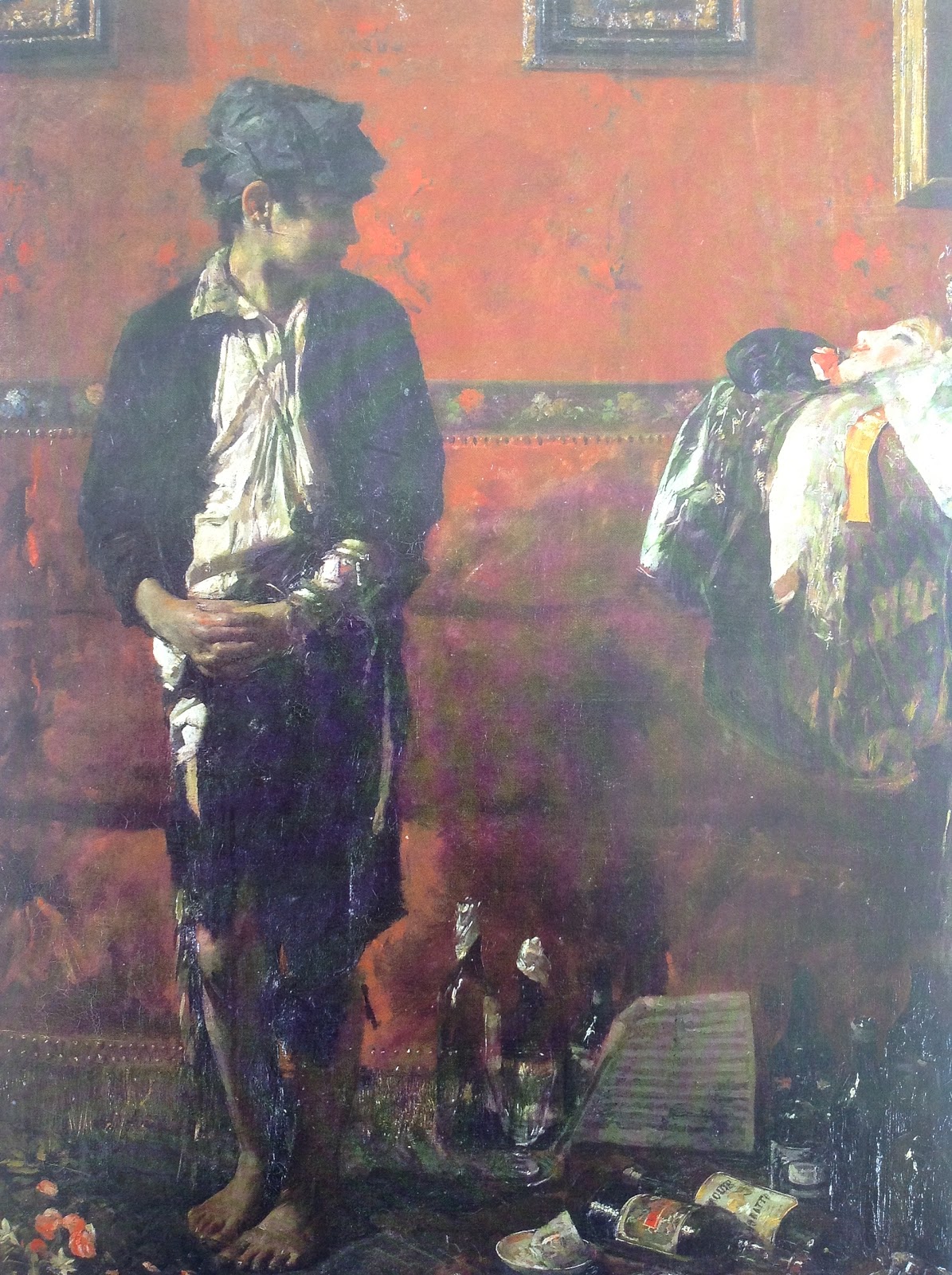
Antonio Mancini: Nineteenth-Century Italian Master. A review.

Antonio Mancini: Nineteenth-Century Italian Master. Cover photo.


Antonio Mancini. The Street Urchin, c. 1868. Oil on canvas.


Antonio Mancini. Scugnizzo with Crucifix, c. 1875. Oil on canvas laid down on board.


Antonio Mancini. The Saltimbanco, c. 1877-78. Oil on canvas.


Antonio Mancini. Sir Hugh Lane, c. 1906. Oil on canvas.
Looking back on my previous posts, I find that I have neglected painting and, to a lesser degree, sculpture, at the expense of drawing. This is owing not to a preference for any of these mediums, but due to my belief that drawing is the foundation of the other two.

Regardless, I would like to rectify that omission with a review of a book I have recently acquired. Antonio Mancini: Nineteenth-Century Italian Master by Ulrich W. Hiesinger was published by the Philadelphia Museum of Art in 2007 and is, unfortunately, out of print. Second hand copies are expensive, but Mancini is a neglected painter who deserves more attention and the book is a worthwhile addition to any painter's library.

Mancini was born in 1852 in Rome. During his lifetime he was a celebrated painter who John Singer Sargent referred to as "the greatest living painter." High praise from a genius such as Sargent. Mancini flirted with mental problems during his thirties and financial problems most of his life. But he overcame these obstacles to produce a wonderful body of work. At his best, Mancini employs a mesmerizing understanding of light and a keen insight into his subject that rivals Sargent.

Mancini led an interesting life with numerous problems and I was intrigued by his story as well as his painting. It's a pity that this book isn't more widely available.

Tuesday, 1 January 2013

Fascinated By Faces.

Michael Whynot. Facial Study, 2012. Red chalk.

Leonardo Da Vinci. Head of a Girl, c. 1483.

Rembrandt van Rijn. Self-portrait in a cap, with eyes wide open, c. 1630.

Pietro Annigoni. Mr. Rydy. Oil, 1949.

Gian Lorenzo Bernini. Innocent X

The aim of the artist is to represent not the outward appearance of things, but their inward significance. (Aristotle)

A face is not well done, unless it shows a state of mind. (Leonardo Da Vinci)


To be fascinated by the form of the human face is to be fascinated by emotion - for it is through the attitude of its anatomy that emotion is conveyed more readily than through any other part of the body (see my post on hands and feet).

The face is a complex form, made more so by the extensive variety of expressions produced by the facial muscles, and may take the artist years to master.

Structure and likeness are the two aspects of the face most easily studied. Likeness is all about comparative measurement, one feature against another, and, as such, can be distilled down to a mechanical process. And structure is built upon the skull - the boney foundation of the face - and lends itself to anatomical study.

But careful measuring and understanding of the form, while producing an accurate rendering, is not enough. The result may prove unsatisfying if the artist ignores the, less tangible, aspect of emotion; state of mind; expression. The artist must endeavour to understand the state of mind of the subject if they are to produce a work that is more than run of the mill.

And here is where many of us falter, since rendering a state of mind has no easily studied rules and does not lend itself to learning or teaching.

But, having said that, I believe that a fundamental interest in human nature is a fine jumping off point from which to embark. Also, time spent watching the sitter (no measuring allowed) will prove beneficial. A final tool (which you may or may not be able to cultivate) is a sensitive temperament, a trait I believe can be nurtured only by studying yourself, not the sitter. But, when taken seriously, the rewards may be manyfold.

A great work of art is universal, for in it, sitter, artist and viewer each glimpse themselves.