Showing posts with label drawing. Show all posts

Wednesday, 19 August 2015

Lines of the Day: August 19, 2015.

Michael Whynot. Head studies. Red chalk.


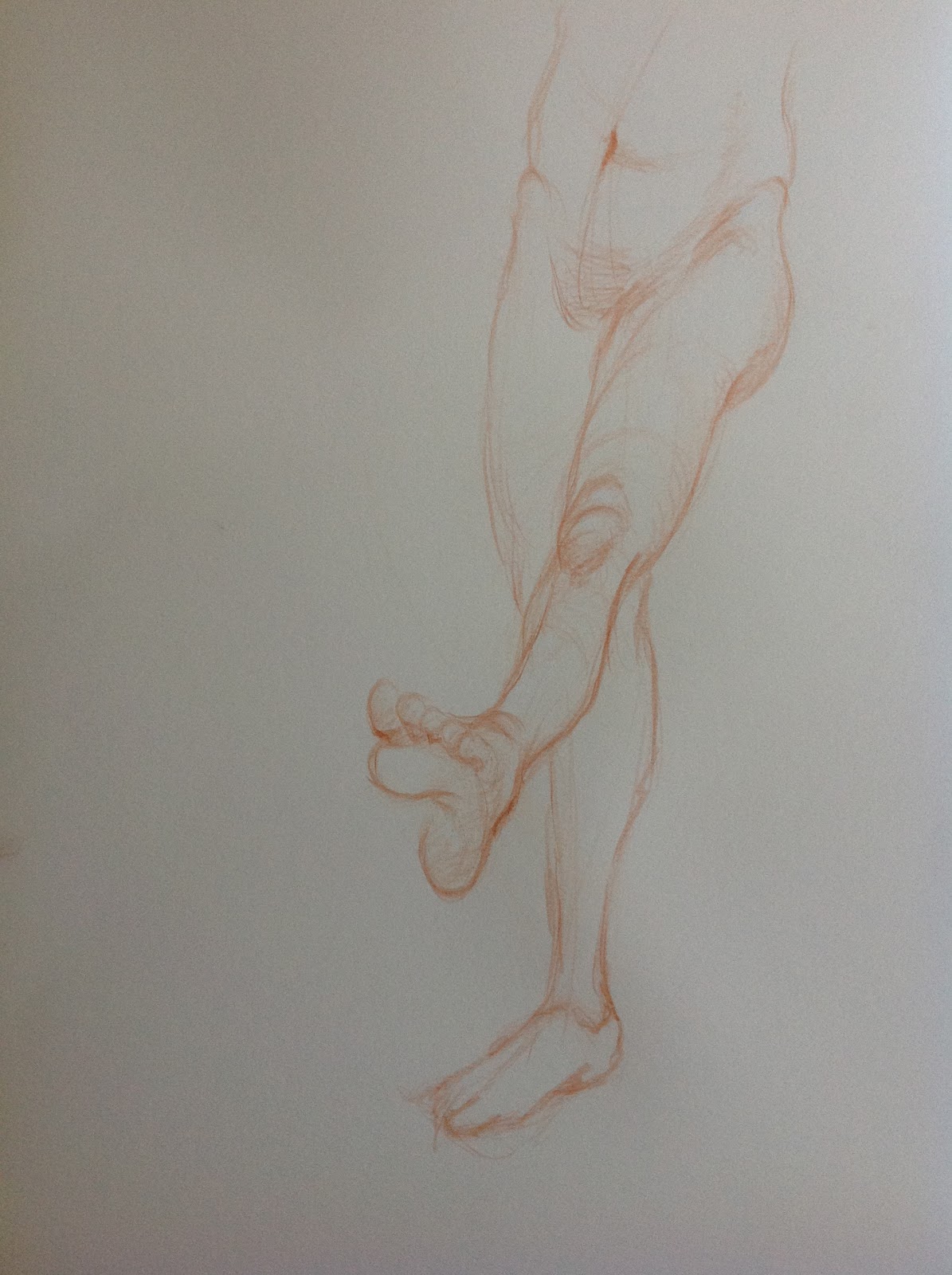
Why is the human form so challenging to draw? Why do draftsmen struggle with the head, for instance? It is due to the simple fact that we are attempting to represent on a two dimensional surface, something which is constructed in three.

Notice that when children draw the head, it is usually in profile, or straight on, and typically flat; they ignore the dimension of depth entirely. But, if we want to progress in our work, we must embrace depth.

And, even then, if we think we have a system down for drawing the head, suddenly the model turns to a three quarter view, and everything changes; that is our next problem: three dimensional objects, in nature, rarely look the same once our point of view changes. Heads twist, tilt, raise and lower; often doing all simultaneously. And every part of our human anatomy poses similar difficulties. This is why mastery of the human form can take a lifetime. But, like any ability, hard fought for, the rewards are well worth the struggle.

Monday, 8 June 2015

Drawing: Structure, the Foundation of Form.

Michael Whynot. Portrait study. Red chalk.


Michael Whynot. Portrait study (early stage). Red chalk.


A good drawing begins with gesture: a unifying thrust flowing through the form. But, once the gesture is captured, the draftsman must shift their attention to the skeletal structure underlying the form. Whether this is something they draw in any detail depends upon the individual draftsman. The better they understand the structure, the less they need to actually draw it. And, this rule applies to anatomy in general: the better you understand it, the less important it becomes, because you internalize the entire process.

Above, top, is a one hour drawing I did earlier today and the initial, block-in stage, beneath it, showing some of the bone structure which occupied my thinking as I began.

But, again, once you know the structure, you don't need to consciously consider every bone and and muscle; you understand where they are, so you see and use them without thinking - like following your familiar route home at night.

Sunday, 22 February 2015

A Mind for Figures.

Michael Whynot. Figure study. Red chalk.


Michael Whynot. Figure study. Red chalk.


This is my first post in over a year. I must admit to having these recurring bouts of fatigue and self-doubt. Doubt in my ability, my goals, and my own will to accomplish them. On such days, I feel that nothing I create is of any worth and that I have progressed as far as I am able to. These are the times when I find it much easier to become side-tracked, by my other diverse interests, than to draw. It's like watching a baseball being thrown at your head, but being unable to step out of harms way.

I am trying to get back on track, though, with this new post and these two drawings from imagination. The human figure occupies my mind constantly and drawing seems to be the only way to release them.

Aristotle said: "We are what we repeatedly do. Excellence, therefore, is not an act but a habit."
So, I will attempt to get back into the habit of drawing regularly every day. Wish me luck and, if you like these figure studies, please share your thoughts.

Sunday, 14 July 2013

A Milestone Reached.

Michelangelo. Creation of Adam.


Beauty is a value as important as truth and goodness. I think we are loosing beauty and there is a danger that, with it, we will loose the meaning of life.    (Roger Scruton)


This blog reached a milestone today: ten thousand page views during the last twelve months.

When I began posting, last August, I meant to explore my ideas concerning the beauty inherent in natural forms - particularly the human form - and to chronicle my journey toward attaining the abilities necessary to depict that beauty in drawing, painting and sculpture, much as Praxiteles, Leonardo da Vinci, Michelangelo and Raphael had done before me.

I have come a long way, but have much further, yet, to go. I would like to thank everyone who has been following my posts, these last twelve months. I hope that you will continue to follow my journey; I hope my work proves worthy of your interest.

Friday, 31 May 2013

Foreshortening Forms

Michael Whynot. Study in Foreshortening, 2013. Red chalk.


Foreshortening is a powerful tool for the draftsman to add dimensionality to their drawings. When forms recede from our view in space they become smaller. We are so accustomed to seeing this optical trick in nature that our minds take it for granted and immediately notice, in a drawing, when this isn't done.

When handled properly, by using overlapping forms, the drawing gains dimensionality, with the nearer forms appearing to be in front of the more distant forms. And the form will appear shorter than we know it to be, instead of simply looking out of proportion.

The above study was a five minute study from life.

Monday, 18 March 2013

Gesture as Foundation.

Michael Whynot. Figure Study, 2013. Red chalk.


Michael Whynot. Gesture for the drawing above.


Michael Whynot. Head Study, 2013. Red chalk.


I'm posting some recent drawings today and I'm going to talk a little about gesture. Gesture is, perhaps, the most neglected of all the fundamental skills a draftsman requires. This may be owing to the fact that it is so deceptively simple. We're basically talking about a stick figure. And any four-year-old can draw these; or so it would seem. And, therein, lies the difficulty. A well done gesture captures the rhythm of the figure (see my previous post on gesture). Within it should be contained all the necessary information needed to complete a figure which is the thrust of the forms; the pose. Once you have that, then a knowledge of form, light and anatomy (see my previous post on anatomy) will carry you the rest of the way.

The figure study, above, was done from the gesture drawing shown below it and was, itself, drawn from life several months ago.

Drawing complete studies from life is indispensable for the draftsman but is not always possible. The ability to capture gesture is a basic skill which must not be neglected. Learn to do it and use it as your foundation upon which to build future work.

Monday, 11 March 2013

Overlapping Forms.

Michael Whynot. Figure study, 2013. Red chalk.


Michael Whynot. Figure study, 2013. Red chalk.


Some poses are inherently more challenging to draw than others: namely, any pose where foreshortening and perspective come into play (hint: most of them). Much of the knowledge we learn about proportion goes out the window with these poses. This is where the draftsman's ability to measure comparatively, by eye, comes into play (see my previous post on measuring). And even this can be a challenge, since depth is the most difficult measurement to judge. But describing the forms with a sense of dimensionality or volume can be achieved by a solid understanding of the forms and clarifying which form is in front and which is behind.

Overlapping forms is an aspect of drawing which is easily overlooked by the beginning draftsman. In an academic approach to drawing the figure, he or she is often taught to carefully draw the contour of the figure and, in so doing, they usually combine the contours of separate forms into one with a continuous line, flattening out the drawing and confusing the viewer.

The ability to see how one form fits into another allows the draftsman to emphasize the separation between the two. Taking a constructionist approach to the figure allows the draftsman to understand these forms. From this point there are several ways to clarify the overlapping forms: line weight and sensitivity being the foremost, but also emphasizing the forward form with tone and the use of atmospheric perspective.

The two drawings, above, are from Sunday's life drawing session and were each approximately 20 minutes long. Notice how I try to emphasize the line weight of the forward forms and subdue the weight of line on the forms which pass behind the forward forms. This is a process which takes much practice and must be utilized over every part of the figure (something which I haven't totally achieved on either drawing).

There are many elements to consider in a good drawing- overlapping forms is but one of many- and they must be considered simultaneously and completely internalized, so that they are done without thinking. This is a long process, and one reason why a constructionist approach to drawing the figure takes longer to become proficient in than an academic approach. But the results from a constructionist approach are usually more dimensional and beautiful (beautiful and accurate are not the same thing).

But all of the elements of good drawing stem from proper seeing by the draftsman. And seeing is akin to understanding and visa versa (see my previous post on drawing well). For, if the form is not clear in your mind's eye, it will never be clear in the viewer's eye.

Sunday, 3 March 2013

Focus: The Elusive Piece of the Puzzle.

Michael Whynot. Figure Study, 2013. Red Chalk.

Michael Whynot. Figure Study, 2013. Red Chalk.

Michael Whynot. Figure Study, 2013. Red Chalk.


During this morning's life drawing session, I began wondering to what extent focus plays in good drawing.

For our purpose, The Free Dictionary defines focus as:
4. Close or narrow attention; concentration.
5. A condition in which something can be clearly apprehended or perceived.
Put simply, the process of bringing our attention to bear upon the subject, to the exclusion of all outside distractions; drawing in the zone (to use a sports analogy). That state of mind in which time slows down and hours can disappear down the rabbit hole of focused concentration.

Once we, as draftsmen, have all the necessary tools in place: the ability to describe form with line and tone; an understanding of gesture and anatomy; an eye trained to measure proportion comparatively, then success or failure rests, ultimately, upon the ability to focus our attention upon the subject.

During last week's session, I lacked focus - I struggled with gesture and proportion; I could not visualize the pose, even though I was staring at it. This week I was able to attain focus; I could have closed my eyes and still seen the form - and my drawings were better for it.

Concentration, focus is elusive. I am uncertain what conditions inhibit or nurture it, but I am certain that, whatever the conditions may be, that they reside within me. The obstacles to good drawing are mental, not physical.

At the end of the day, good drawing demands that the artist be present.

Friday, 22 February 2013

Head Study.

Michael Whynot. Head Study, 2013. Red chalk.

I'm posting a head study done this morning from reference. I plan to get back to some life drawing this weekend if it will only stop snowing. The light is grey and cold. What little warmth to be found is hiding amid the shadows. One need look closely to see it, but it is there; it gives me a small measure of hope.

Sunday, 10 February 2013

Ballet of an Idle Mind.

Michael Whynot. Ballet of an Idle Mind, 2013. Red chalk.


I spent the morning staring out of my kitchen window at the snow drifting, three feet deep, in the field. It is difficult to remember summer in the depths of February - warm sunshine on the front steps, a cool breeze stirring the leaves down the long, bright evenings. I never appreciate things until they are gone.

I haven't drawn from a live model now for two weeks. Not a long time, maybe, but I worry if I haven't, perhaps, forgotten the intricate arrangement of the human form, as well. So I visualized a pose and spent an hour drawing from my imagination.

The physical act of drawing is a motor skill - not that different from driving a car or swinging a golf club. The art in drawing comes from being able to visualize a form, whether that form is ten feet in front of you or floating around inside your head. And this, like everything we strive to do well, takes practice. Drawing will never be easy, but experience tells me that it will get easier.

Thursday, 17 January 2013

Drawing of the Day.

Michael Whynot, 2013. Portrait study. Graphite.


Draw something every day. Don't compare yourself to anyone else. There will aways be some some draftsman who is better than you are. Down this path lie feelings of inadequacy.

Ask yourself one question: Is your work better today than it was yesterday? Your goal should be steady improvement. Save every drawing; date them. You will be amazed at your progress when you pull out last years drawings and compare them to your current work. Persevere.

Sunday, 13 January 2013

Marginal Drawings.

Michael Whynot. Pencil drawing, 2013.


Michael Whynot. Red chalk drawing, 2013.


Michael Whynot. Pencil drawing, 2013.


Michael Whynot. Red chalk drawing, 2013.


I strive, daily, to be a better draftsman; all of us who draw do this. It is in our nature. We all endeavour to do better, that which we have a calling to do. It is the trait in human nature which spurs us on to great things.

In the course of writing this blog, I began to notice that I was drawing in the margins of my notebook - no great works of art, to be sure, but I believe that it says something about the mindset necessary if we are to improve our abilities. We must draw constantly (or sculpt, or paint). Practice is the surest path to improvement. Drawing must eclipse all else. It will always be easier to watch television, or read a book, or even write a blog than to put in the necessary time practising. But I know of no other way: practice, practice, practice.

Draw without ceasing; never concede. Draw, even when you can't draw, your mind as your pencil, your memory the paper.

Monday, 7 January 2013

The Study: Foundation of the Creative Process.

Michael Whynot. Head study, 2013. Red chalk.

Design, or as it is called by another name, drawing, constitutes the fountainhead and substance of painting and sculpture and architecture and every other kind of painting and is the root of all knowledge.  (Michelangelo)


Just posting a quick head study (3"x4") done this morning in preparation for a clay figure. Sometimes it is faster to find the pose in chalk than to work directly in the clay. There is such an economy of effort with drawing which allows the artist to explore a range of possibilities he might otherwise neglect. And, it is the process of exploring different concepts in the drawn form, from which can spring a totally unique idea. The act of creation is mysterious, indeed, but I believe drawing plays a fundamental role.

When God created man, I like to imagine that He began by first exploring His concepts for the human form through a series of loose, preliminary drawings before ever committing them to flesh and bone.

Tuesday, 1 January 2013

Fascinated By Faces.

Michael Whynot. Facial Study, 2012. Red chalk.

Leonardo Da Vinci. Head of a Girl, c. 1483.

Rembrandt van Rijn. Self-portrait in a cap, with eyes wide open, c. 1630.

Pietro Annigoni. Mr. Rydy. Oil, 1949.

Gian Lorenzo Bernini. Innocent X

The aim of the artist is to represent not the outward appearance of things, but their inward significance. (Aristotle)

A face is not well done, unless it shows a state of mind. (Leonardo Da Vinci)


To be fascinated by the form of the human face is to be fascinated by emotion - for it is through the attitude of its anatomy that emotion is conveyed more readily than through any other part of the body (see my post on hands and feet).

The face is a complex form, made more so by the extensive variety of expressions produced by the facial muscles, and may take the artist years to master.

Structure and likeness are the two aspects of the face most easily studied. Likeness is all about comparative measurement, one feature against another, and, as such, can be distilled down to a mechanical process. And structure is built upon the skull - the boney foundation of the face - and lends itself to anatomical study.

But careful measuring and understanding of the form, while producing an accurate rendering, is not enough. The result may prove unsatisfying if the artist ignores the, less tangible, aspect of emotion; state of mind; expression. The artist must endeavour to understand the state of mind of the subject if they are to produce a work that is more than run of the mill.

And here is where many of us falter, since rendering a state of mind has no easily studied rules and does not lend itself to learning or teaching.

But, having said that, I believe that a fundamental interest in human nature is a fine jumping off point from which to embark. Also, time spent watching the sitter (no measuring allowed) will prove beneficial. A final tool (which you may or may not be able to cultivate) is a sensitive temperament, a trait I believe can be nurtured only by studying yourself, not the sitter. But, when taken seriously, the rewards may be manyfold.

A great work of art is universal, for in it, sitter, artist and viewer each glimpse themselves.

Thursday, 27 December 2012

The Beauty of Forms.

Michael Whynot. Torso Study, 2012. Detail. Water-based clay.

Michael Whynot. Torso Study, 2012. Detail. Water-based clay.

Michael Whynot. Torso Study, 2012. Detail. Water-based clay.

Michael Whynot. Torso Study, 2012. Detail. Water-based clay.

Michael Whynot. Torso Study, 2012. Detail. Water-based clay.

Michael Whynot. Torso Study, 2012. Detail. Water-based clay.

Michael Whynot. Torso Study, 2012. Detail. Water-based clay.

Michael Whynot. Torso Study, 2012. Detail. Water-based clay.

Michael Whynot. Torso Study, 2012. Detail. Water-based clay.

Michael Whynot. Torso Study, 2012. Detail. Water-based clay.

There is nothing ugly; I never saw an ugly thing in my life: for let the form of an object be what it may -  light, shade and perspective will always make it beautiful. (John Constable)


Light reveals form - which is a beautiful thing - that can be infinite in its variety, owing to its orientation to light and the viewpoint of the beholder.

In a drawing, the draftsman fixes the source of light and the viewpoint of the beholder to a single moment in time, in essence, selecting a moment from the infinite for each new drawing. But the sculptor, creating in the round, is able to offer infinite variety in a single work. Both the sculptor and the draftsman offer infinite variety: the sculptor in a single work, the draftsman in many.

Note the variety in the photos of my clay torso study above. Each is taken from a different viewpoint and orientation to the light source. A draftsman could create many different drawings from the photos, while the sculptor creates one work with infinite variety.

As men have done since the beginning of time, I become lost when pondering the infinite, the possibilities for beauty being endless. The artist's job is to embrace one of these moments of beauty from among the infinite variety available and endeavour to convey it to others so that they can see form as the artist sees form. The degree to which the artist succeeds is dependent upon their ability to clearly render, not only the form, but the essence of the form which is beyond verbal definition and is the crux of the artist.


                                    The Beauty of Forms.

                             That I am blessed to bear witness
                             To the beauty of forms
                             Amid these common aspects of daily life;
                             But, oh, how it consumes me,
                             Like a flame,
                             As I struggle to release it,
                             Burning me
                             From the inside out.

                                                      (Michael Whynot, 2012)


Friday, 7 December 2012

Pursuing Gesture: The Legacy of the Greeks. Part one.

Greek, 2nd century B.C. Torso of Satyr.
Michelangelo. A Battle Scene, c. 1504
Raphael. Men Fighting (1504?).
Gian Lorenzo Bernini. David, 1624.
Frank Frazetta. Mid-20th century.
Patricia Hannaway
Patricia Hannaway.
Michael Whynot. Thirty second gesture drawing, 2012.
Michael Whynot. Fifteen minute torso study, 2012.


I have touched upon gesture in a previous post, but I find myself returning to it again and again, the eternal moth to the flame, since it lies at the heart of everything I find beautiful in art.

Gesture is not new, nor is it limited to a single time period. Great artists, since antiquity, have been capturing it, imbuing form with life.

Sometime around 480-450 B.C., Greek art began to evolve. Up until that point there was an unnatural lifelessness inherent in their sculpture and painting. It was hard and cold and lacked what we now refer to as gesture. But once the Greeks were able to overcome the initial stiffness of their early work (see the beautiful, 2nd century B.C., Torso of a Satyr, above), the vitality of the gesture has flowed down the ages, from the Greeks to the Romans, from Michelangelo, Raphael and Bernini, to modern artists.

Frank Frazetta was able to capture the essence of movement in a few perceptively placed ink strokes. Long time animator, Patricia Hannaway, has a lovely, expressive touch with line and light. Lastly, I have included a thirty second gesture drawing and a fifteen minute torso study of my own.

Life moves quickly, so the artist's eye must move quicker still; must notice even more. Gesture neither begins nor ends, but is in a constant state of flux. What a wonderful ability: to pluck life from between God's own fingers and shape it into material form, the grace of which others might now behold and wonder that they had never before noticed such beauty.

Life unravels too quickly, too quickly altogether. Art offers us a respite, a chance to breathe and experience the wonder of existence; art is a nightlight shinning at 3:00 in the morning.

Monday, 19 November 2012

To Measure Or Not To Measure

19th century Academic drawing.

Frank Frazetta c. 1975. Pen and ink.


"An artist must have his measuring tools not in the hand, but in the eye." Michelangelo


Reading the above quote from Michelangelo, you can guess where I stand on the issue of measuring in regards to good draftsmanship.

Mechanical measuring to very exacting standards is a process now being taught in many art schools and  ateliers. While this is certainly one way of obtaining acceptable results in a reasonable amount of time (months, as opposed to years), I would submit that, for many artists, the practise can become a crutch and will actually hinder their progress in the longer term.

By adhering to a reliance on mechanical measuring, the student will never train their eye. They may never learn to comparatively measure form and distance without their plumb lines and straight edges. And, to my mind, learning to measure proportion by eye is the foundation upon which good draftsmanship is built.

Also, accuracy of measurement is only one aspect of a good drawing and, arguably, not even the most important aspect, but should certainly be accomplished by eye if the draftsman is not to become a prisoner to nature. Drawing from the imagination becomes an impossibility if the draftsman hasn't learnt to measure form by eye.

And, at some point in the drawing process, the artist needs to let go of the impulse to measure everything for accuracy; incessant measuring can stiffen a drawing, threatening your initial gesture and draining it of any freshness it may have had. Better to have a vibrant drawing with subtle, sensitive line that is not perfectly accurate, than a completely accurate drawing, devoid of all life.

I have included two drawings by way of example. The first is an academic figure study from the 19th century and comparable to much of the work currently being produced. The second is a pen and ink drawing by Frank Frazetta, c. 1975 (certainly one of the 20th centuries most underrated draftsmen). While both drawings are accurate, Frazetta drew by eye and often from his imagination; the resulting drawing achieves a dynamic freshness which is lacking in the 19th century study which was likely drawn directly from the model and mechanically measured, resulting in a drawing which is stiff and overworked by comparison.

Accuracy of draftsmanship is certainly an important destination for the artist, but of these two paths to attaining that goal, one can be, for many, a dead end.

A drawing's success is built upon the eye's ability to measure comparatively, one form against another, and the heart's ability not to measure the life out of it.