Showing posts with label figure drawing. Show all posts

Sunday, 23 August 2015

Lines of the Day: August 23, 2015.

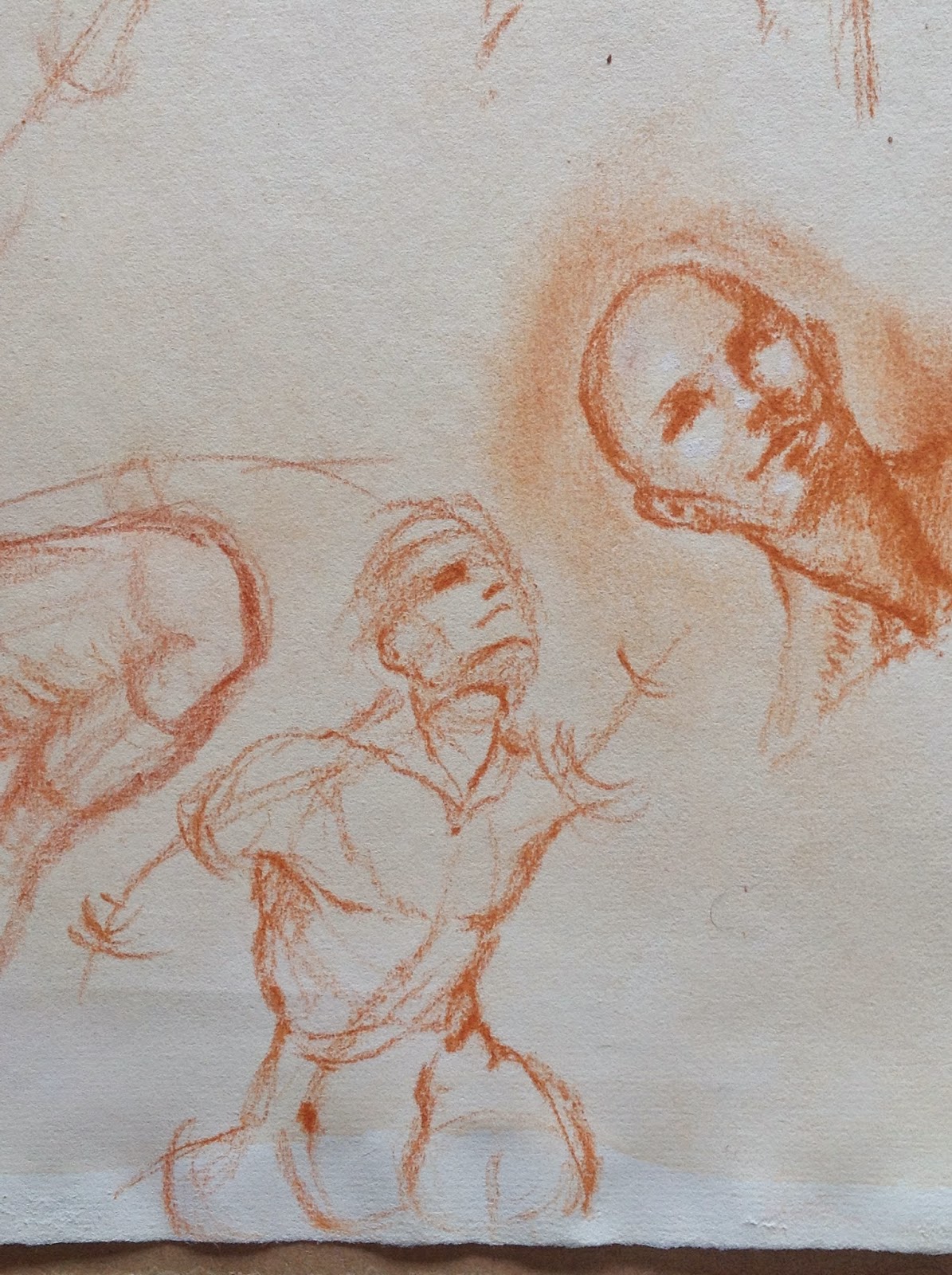
Michael Whynot. Torso study. Red chalk.


A five minute torso study, from imagination. A constructionist approach to drawing focuses on structure; and once that structure is understood, a solid foundation is laid for the exploration of infinite variations on that structure. Herein lies the path to creativity.

Monday, 27 July 2015

Lines of the Day: July 27, 2015.

Michael Whynot. Figure study. Red chalk.


Michael Whynot. Head study. Red chalk.


Michael Whynot. Head study. Red chalk.


Michael Whynot. Figure studies. Red chalk.


Michael Whynot. Sketch book page. red chalk.

Hand refined linseed oil.


Assorted, quick figure studies today, drawn from imagination. Trying to accomplish twelve things at once: I'm just getting to the end of Ernst Van De Wetering's book, Rembrandt: The Painter At Work, a great inquiry into the artist's Materials and working methods; getting my lines of the day down on paper; updating the blog; and learning the process of preparing my own linseed oil in preparation for making my oil paints.

Things are progressing, but it seems like there is so much to learn and so little time.

Sunday, 14 June 2015

Lines of the Day: June 14, 2015.

Michael Whynot. Figure study. Red chalk.

Today's lines were done over the last two days; ten minutes here, ten minutes there. Total time, maybe an hour. I'm not completely satisfied with it. It was done from imagination and I struggled with some of  the details. This is where a live model would have been helpful in sorting out areas which were anatomically unclear in my mind. For me this is usually the attitude of the limbs and problems with perspective. Still, not a total loss.

Friday, 5 June 2015

Lines of the Day: June 5, 2015.

Michael Whynot. Red chalk studies.


Apelles of Ko, the renowned painter of ancient greece, was supposedly very diligent in his practice of drawing. He is attributed with the famous saying: Nulla dies sine linea - "Not a day without a line drawn."

While I'm uncertain whether I am as diligent as Apelles, I do try to draw something on most days. I will endeavour to post some of these "lines of the day" on a more regular basis.

Thursday, 21 May 2015

Drawing the Figure: Constructing Versus Copying.

Michael Whynot. Figure studies. Red chalk.


Michelangelo. Study of a Seated Young Man.


Degas.


There are two separate paths on which the draftsman can travel on their journey toward drawing the figure. You can think of them as constructing versus copying; line versus mass; 3-dimensional versus 2-dimensional. But what it comes down to, is that there are two different ways of seeing form.

Michelangelo appeared to take an analytical, constructionist approach to drawing his forms, whereas Degas seemed to utilize the approach of copying the flat, 2-dimensional shapes he saw before him. While either approach can lead to fine drawings, I would argue that Michelangelo's approach creates drawings with more depth and movement or life.

I have chosen to pursue the constructionist approach with my drawings. The differences between the two approaches is often subtle and I continue to explore and trace the many nuances in reasoning that Michelangelo's mind may have followed that led to his particular way of seeing. His image of himself a a sculptor, as opposed to a painter, intrigues me; but Degas was, also, a sculptor and a painter, although I am uncertain which of the two he viewed himself to be. The mindset needed by the sculptor, the spatial vision required to deal with forms in space may be an area worth pursuing. Drawing is a path with many turns.

Sunday, 5 April 2015

The Nude Figure and the Clothed Figure.

Michael Whynot. Study of mother and child. Red chalk.


Michael Whynot. Figure study. Red chalk.


Here are a couple of studies done this morning, one nude and one clothed. The drawing of nude figures, although beautiful in themselves, have also been used as preparation for clothed figures at least since the renaissance.

So much in drawing is about the understanding of form, and once the draftsman understands how the body is constructed, it then becomes a matter of wrapping the figure in clothing, just as an understanding of the skeletal system serves to ease the draftsman's ability to wrap the skeleton in muscles and flesh.

Wednesday, 25 March 2015

Beauty, Expressiveness and the Human Figure.

Michael Whynot. Figure Study. Red chalk.


The range of beauty and expressiveness possible within the attitude of the human figure never fails to leave me with a sense of wonder. The flesh is the veil through which we glimpse the soul.

Is it any wonder that the figure has been the focus of art since we first began to draw?

The drawing above began with a few quick gesture lines. I had a simple twist of the torso in mind when I set down with my drawing pad. I began to explore the figure on the paper, changing the gesture lines for the neck, arms and legs. The range of possibilities was nearly endless.

An hour later, I had this expressive figure on the page, the head lolling against the shoulder, knee thrusting forward, arms spread wide.

A person could spend a lifetime exploring all the possibilities of the figure and, I dare say, it would not be a life wasted.

Wednesday, 18 March 2015

Snow Day Drawings

Michael Whynot. Red chalk gesture drawings.

Detail.


Detail.


We received a huge amount of snow here, last night and this morning; spring can't get here soon enough.

On the bright side, it gave me an hour to play around with some  rough gesture drawings, exploring different poses for the figure. This is where you can give your drawing free rein without the constraints of drawing directly from life. And it's a lot of fun.

Wednesday, 25 February 2015

The Sum of the Parts.

Michael Whynot. Figure study. Red chalk.


Michael Whynot. Foot study. Red chalk.


Michael Whynot. Hand study. Red chalk.


Aristotle wrote that: "The whole is greater than the sum of its parts." And, while this is certainly true of the human form, where the inherent flow of gesture from one body part to the next can create a grace and emotional connection more profound than the summation of the individual pieces, I would argue that the individual forms, when studied in isolation, can convey a grace and beauty all their own.

There is no question of the wondrous flow of gesture through the legs, hips and torso above, yet, if you study the arm or the leg and the attached hand or foot, taken in isolation, you will find the same ebb and flow through these parts as well.

The organic form is a wonder of engineering, evolution, or creation (whichever term you prefer). It has captivated our souls and our art since we first made marks upon the walls of dimly lit caves and it continues to captivate us today. The fact that such continuity of form, that flowing gesture of grace, is evident no matter how small a piece of the whole we observe, speaks to the profound truth of Aristotle's quote. The whole is, indeed, greater than the sum of its parts, which is greater than the sum of its parts, which is greater than the sum of its parts… ad infinitum.

Sunday, 22 February 2015

A Mind for Figures.

Michael Whynot. Figure study. Red chalk.


Michael Whynot. Figure study. Red chalk.


This is my first post in over a year. I must admit to having these recurring bouts of fatigue and self-doubt. Doubt in my ability, my goals, and my own will to accomplish them. On such days, I feel that nothing I create is of any worth and that I have progressed as far as I am able to. These are the times when I find it much easier to become side-tracked, by my other diverse interests, than to draw. It's like watching a baseball being thrown at your head, but being unable to step out of harms way.

I am trying to get back on track, though, with this new post and these two drawings from imagination. The human figure occupies my mind constantly and drawing seems to be the only way to release them.

Aristotle said: "We are what we repeatedly do. Excellence, therefore, is not an act but a habit."
So, I will attempt to get back into the habit of drawing regularly every day. Wish me luck and, if you like these figure studies, please share your thoughts.

Sunday, 14 July 2013

Drawing Between the Lines: Achieving Dimensionality.

Michael Whynot. Leg study in red chalk, 2013.


I began this post by preparing to upload a recent leg study without much in the way of commentary, but then I took a moment to consider the process of what I had drawn. Achieving a sense of dimensionality in the figure doesn't just happen; and it certainly won't happen by slavishly copying the external contours of the figure.

The eye of the viewer must be coaxed inside the form and away from the external contour. The way to do this is by not placing a hard outline around your forms, which is exactly what most beginning draftsmen struggle obsessively to copy from the model. Line quality and line weight are tied intrinsically to this aspect of good drawing.

Where to emphasize or not emphasize an external contour is an aesthetic decision that really defies rules, so study Michelangelo, Raphael, Da Vinci and Pontormo to understand how it should look when done well.

To persuade the viewer's eye to dwell within the contours, you must give it something to look at. The nearer forms must be modelled upon those forms which are farther away; in this way, depth is achieved.

Creating the appearance of dimensionality of a three dimensional form in space upon a two dimensional surface is not easy, but the sense of wonder it elicits is magical and well-worth our time and study.


Saturday, 15 June 2013

Study of the Arm and Hand.

Michael Whynot. Study of the Arm and Hand (after Michelangelo's sculpture, Victory), 2013. Red chalk.

I'm posting a study of the arm and hand (after Michelangelo's sculpture, Victory). I completed it this morning (20-30 minutes).

 There is something magical in Michelangelo's figures; some movement or flow of the forms which is missing from many other artist's work. We should explore his work closely if we want to elevate our own work. There is a reason why he is still revered nearly 450 years later. Study his forms closely; there are secrets to be found there.

Sunday, 26 May 2013

The Poetry of Movement.

Michael Whynot. Figure Study, 2013. Red chalk.


Michael Whynot. Torso Studies, 2013. Red chalk.

I'm posting two studies taken from my sketchbook from yesterday. There is such beauty in the movement of the human form, rhythm serpentining through the figure, uniting the parts; reminiscent of poetry or music, yet perceived by the eye, instead of the ear. I suspect that some rhythms may be uplifting, while others appear depressing, joyous or sad.

Just as music or poetry can touch us in spiritual ways - which we have all felt, yet, ultimately, been unable to explain - so too, movement of form has the same power to inspire. Such is the mystery of great art, in all its forms.

The figure is capable of conveying a multitude of emotion through its movements. I continue to explore its limits with constant wonder and awe.

Monday, 20 May 2013

Robert Liberace

Robert Liberace

Robert Liberace

Robert Liberace

Robert Liberace

Robert Liberace


Since I began this blog, last year, I have been documenting my journey as a figurative artist by posting my own work and thoughts on figurative drawing, sculpture and painting, as well as some of my influences from the classical tradition: Michelanglo, Da Vinci and Raphael.

I have shied away from pointing to many living influences, because, often times, such lists can end up looking like a sort of popularity contest. That being said, I would like to suggest that we, as draftsmen, should take a serious look at the work of Robert Liberace, whose work compares very favourably to the classical influences I mentioned, above.

Mr. Liberace's figures capture the elusive aspect of movement, furia, which (along with grace, grazia, and variety, varieta) was one of the cornerstones of renaissance art. During that period, great importance was placed upon the appearance of physical movement as an expression of the movements of the soul. We are now rediscovering these aesthetic values in figurative art, five centuries later.

I have been following Mr. Liberace's work for several years and he and his wife, Lina, have kindly posted a link to this blog on their web site. And, if you are serious about figurative art, you owe it to yourself to view his web site and closely study this master's work.

Sunday, 19 May 2013

Multi-figure Study.

Michael Whynot. Multi-figure Study, 2013. Red chalk.

I'm posting this multi-figure study done this morning from reference. The figures are clothed this time, as requested by one of the readers of this blog. As explained in my last post, drawing the nude figure has always been the draftsman's greatest challenge. The use of clothing actually makes the figures easier to draw, in many respects. The folds and edges of the clothing as it wraps around the figure can help explain the orientation of the forms in space.

This, being a multi-figure composition, however, compounded the usual difficulties in judging proportion and perspective. I spent several hours on it and I'm still not, totally, satisfied with it.

Saturday, 18 May 2013

Deliberate Practice and Figure Drawing, Part 2.

Raphael Santi. Study for Massacre of the Innocents, c. 1510. Red chalk.

Raphael Santi. Study for Massacre of the Innocents.

Raphael Santi. Study for Massacre of the Innocents.


The woods are lovely, dark, and deep,
But I have promises to keep,
And miles to go before I sleep,
And miles to go before I sleep.

                                               (Robert Frost.)


In my last post, I touched on the subject of deliberate practice, and since that time I have been asked why my drawings are confined to nudes; no clothed figures.

The answer is that I always draw with a purpose, I never doodle; my practice is deliberate. I struggle with the question of whether greatness requires talent or hard work or both. And here is the problem: no one really knows. So my tactic has been to make a commitment, work hard, and see where it leads me.

Drawing the human form has long been considered the ultimate challenge for a draftsman. The human body's complexity of interconnected forms - which change their appearance immensely with changes in point of view, lighting, exertion, gravity, and numerous other factors - offer a mind-numbing amount of information.

Artists have risen to this challenge for thousands of years. The Greeks elevated the nude form to incredible heights in the 2nd century BC and artists, ever since, have considered mastery of the nude form as a rite of passage. And, once the nude has been mastered, any other drawing challenge will pale in comparison.

I believe that all clothed figures should begin with an understanding of the nude, just as all nudes should begin with an understanding of gesture; as the body is revealed through the surface of drapery, so is the body the veil through whose surface is revealed the soul.

To draw the figure convincingly, the artist must understand the form (see my previous post on drawing well). Then the figure may be draped in clothing and still retain believable volume and dimensionality. Note in the above studies, by Raphael, that he has begun his figures as nudes before adding the drapery.

I believe that deliberate practice - and, by this, I mean focused, persistent attention to the subject under study to the exclusion of all else - is the only way to achieve mastery of a subject, even when the concept of talent is considered. So, in respect to drawing the human form, it means drawing the nude figure obsessively, for years, until every aspect of the form is internalized and the figure can be drawn from any point of view, in every aspect in three dimensional space, from imagination.

So, be mindful of how you practice, as well as how often you practice: practicing a skill ten thousand time incorrectly will never lead to improvement and will actually be detrimental to improvement. This is  where a frequent, honest assessment of your progress is critical. This can be done by yourself, if you are honest with yourself, or, better still, by a competent teacher or master draftsman.

I have been drawing the nude figure, seriously, for over two years now. I believe that I have made progress along the path upon which I set out, but, like Frost's traveler in his poem Stopping by Woods on a Snowy Evening, I, too, have miles to go before I sleep.


Thursday, 16 May 2013

Never A Day Without A Line: Deliberate Practice and Figure drawing, Part 1.

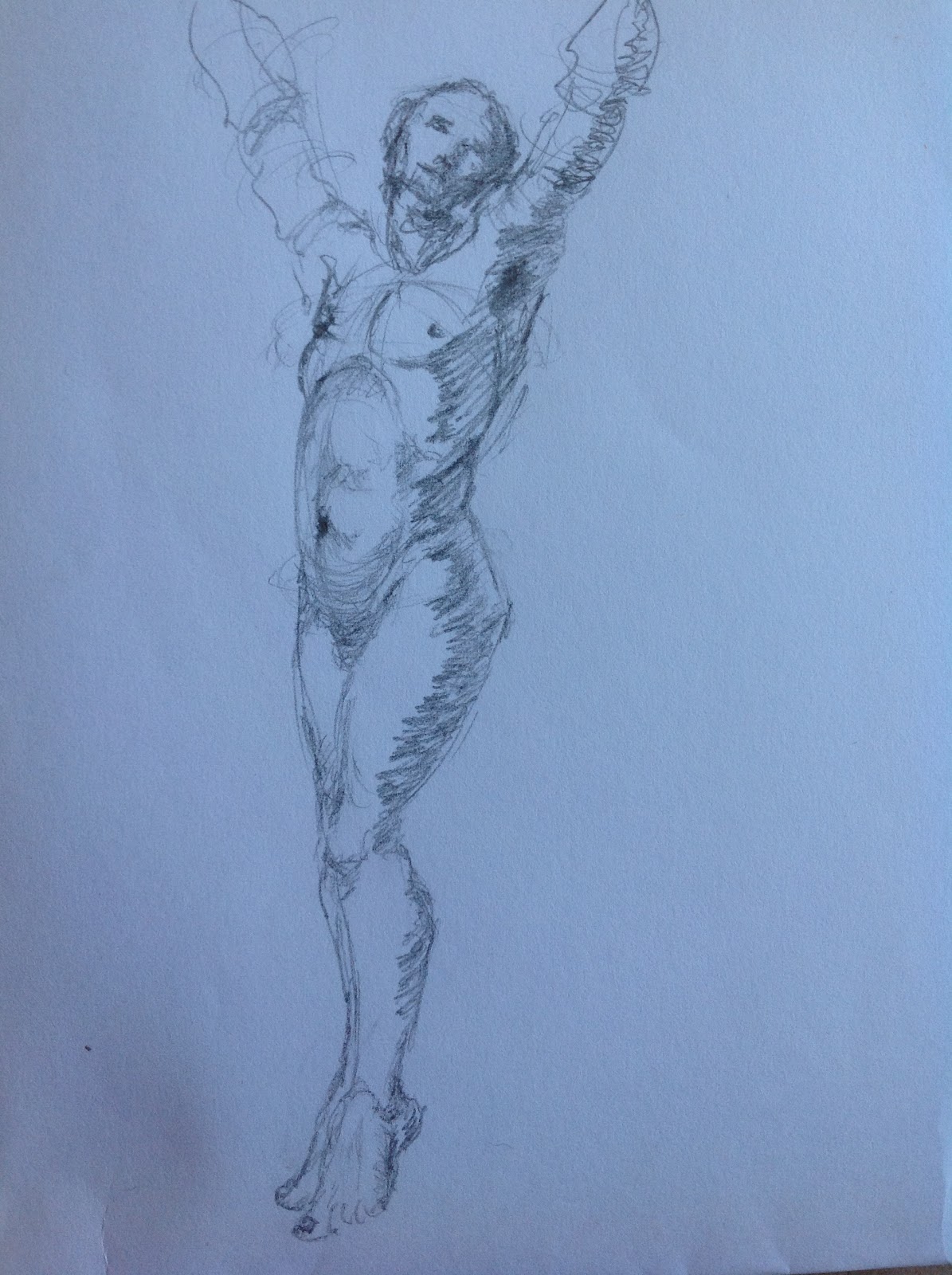
Michael Whynot. Figure Study, 2013. Graphite.


Michael Whynot. Figure Study, 2012. Ink.

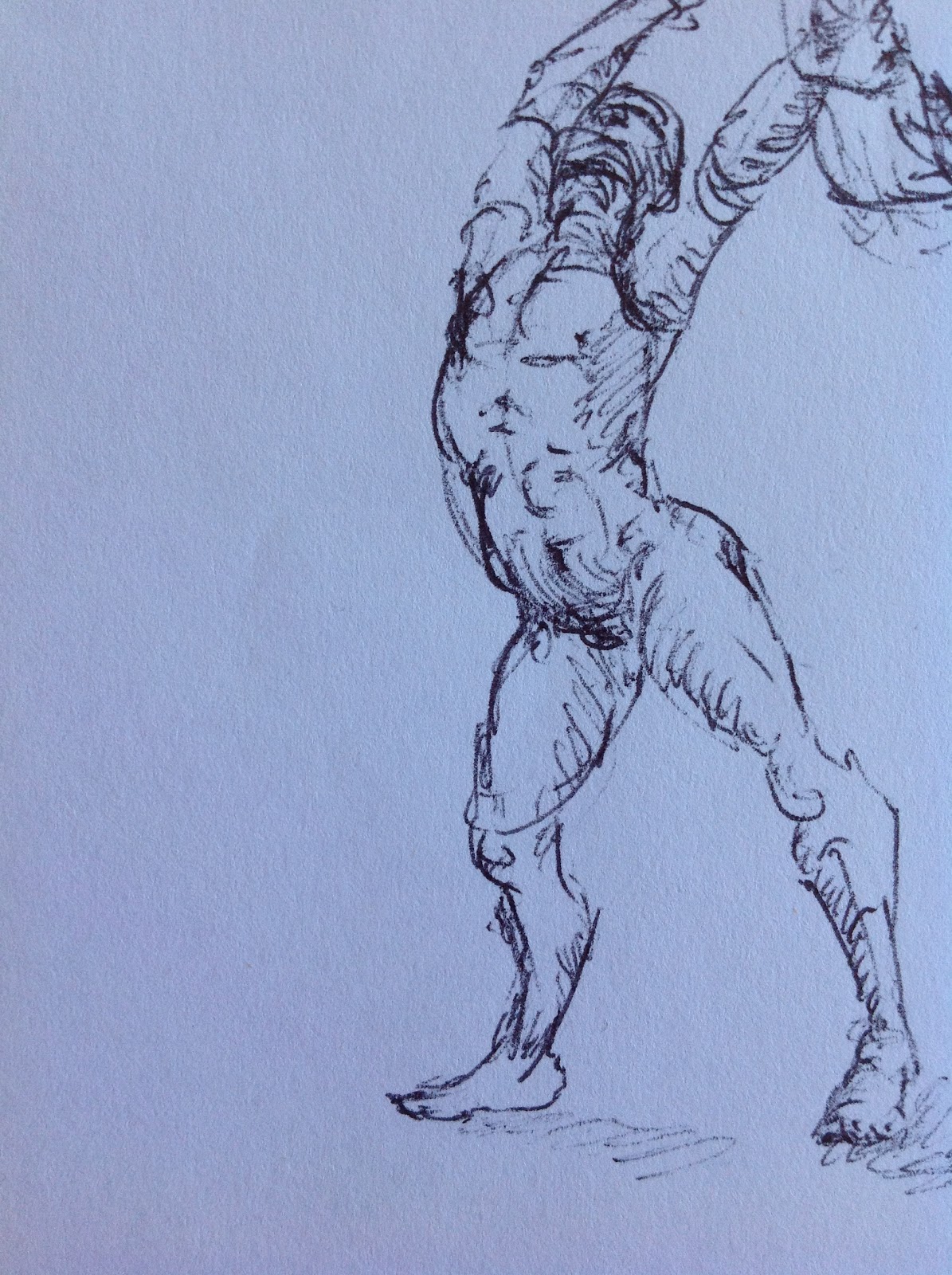
Michael Whynot. Figure Study, 2013. Ink.


Michael Whynot. Figure Study, 2012. Ink.


Michael Whynot. Portrait Study, 2013. Ink.

Just posting a few figure studies done, in spare moments, from imagination and a quick portrait study done from life. All these drawings are quick and small (1 to 3 inches). I do try to draw something every day, without exception.

I believe that the ability to draw well hinges on the ability to see form in a certain way. Seeing form in this way is neither intuitive nor particularly common, but it is a learnable skill and once you do see in this manner, it is difficult to see in any other way. Drawing becomes an exploration of form in space and not merely random doodling. So, practicing every day is the means through which we improve our drawing ability only when we practice deliberately, with purpose. Drawing must never be done absently if we are to improve. Good drawing demands that the artist be present.

Wednesday, 15 May 2013

Life Drawing Figure Study

Michael Whynot. Figure Study, 2013. Red chalk.


This is a figure study, from life (5 minutes), done earlier in the spring in red chalk. Not much more than a gesture originally, and I went back over it this morning and added a light source and some modelling, maybe twenty minutes in all.

I normally use a cream coloured paper and this drawing is on bright, white paper. Looking at the photo, now that I've uploaded it, the colour looks very cold and blue compared to my regular paper. The warm, red chalk really calls out for a warmer paper to achieve a nice, warm middle tone. It also allows you to use white chalk to accent the highlights. Oh, well.

Sunday, 12 May 2013

Emotion of the Drawing

Michael Whynot. Study for A Lingering Doubt, 2013. Red chalk.


A face is not well done, unless it shows a state of mind. (Leonardo da Vinci)


Emotion is a mercurial concept in drawing, but the greatest drawings have it, while mediocre drawings do not. Emotion is an aspect of living, breathing creatures and, if we want our drawings to convey the essence of living things, then we must delve into it.

What is it that draws us(no pun intended) to great art, be it drawing, painting, sculpture, music, literature or poetry? It is the story. We humans love a good story. And what is it that makes a good story? It is, first and foremost, an emotional attachment to the characters. We want to care about the characters; we need to care about them. It is the essence of our true nature.

Emotion brings art to life, so whether it be with a facial expression, a tilt of the head, a subtle gesture of a hand, or the telling curve of the back, endeavour to find the emotional bond to your subject. Emotion, a state of mind, is the mechanism through which we glimpse the inner significance living things; nothing, more or less, than the manifestation of the human soul.

Sunday, 5 May 2013

Study After Michelangelo.

Michael Whynot. Torso Study, 2013 (after Michelangelo). Red chalk.

Michelangelo. Studies of a male torso and left leg. Black chalk.


Michael Whynot. Foot Study, 2013. Red chalk.


Michael Whynot. Study of hand and forearm, 2013. Red chalk.


Nearly four and a half centuries after his death, Michelangelo continues to mystify us. His drawings are, arguably, the greatest ever created, and draftsmen revere his genius with the rendering of the human form. Attempts to copy one of his drawings (see my previous post on Michelangelo) are inspiring, educational and humbling, all at once.

The torso study above was done in about forty minutes and, in it, I attempt a depiction of the gesture Michelangelo drew and not a faithful rendition of the modelling of the forms, which would have taken much longer. Michelangelo's modelling was intricate and beautiful in its hatching, and gave his forms a tangible sense of volume and dimensionality.

I have also posted two studies of feet and hands from this morning's life drawing session. In conversations I had earlier this week, I understand that feet and hands continue to be a problem area for many draftsmen (see my previous post on hands and feet). So force yourself to draw them from life constantly; use a mirror to draw your own hands and feet if you cannot find someone to model for you. Study the structure of the forms; understand what you are seeing; visualize the forms and then draw them (see my previous post on drawing well).