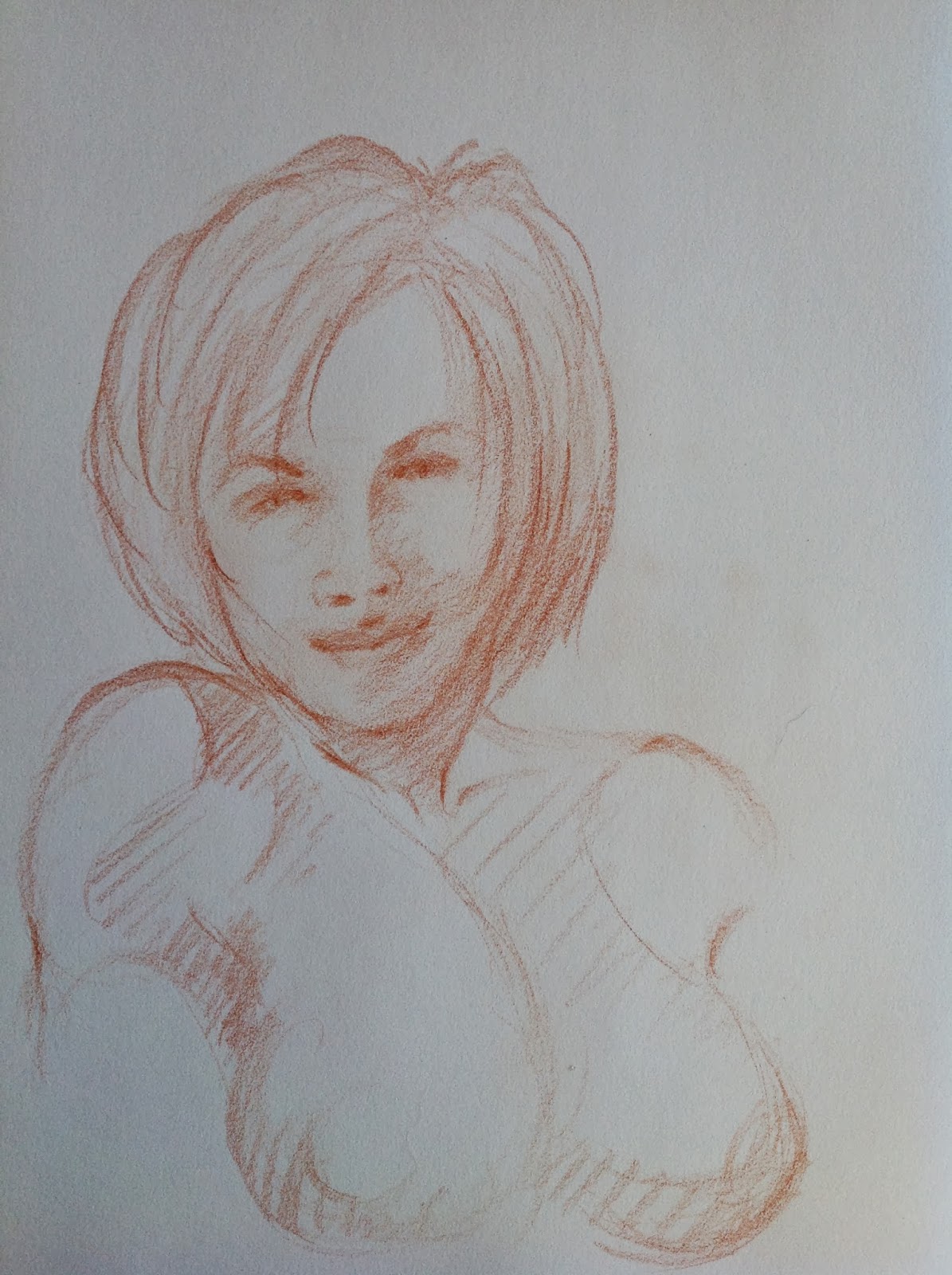
Showing posts with label red chalk drawing. Show all posts

Monday, 7 September 2015

Pentimenti: Exploring Composition.

Michael Whynot. Study of foot. Red chalk.


Michael Whynot. Study of arm. Red chalk.

Michelangelo.


Michelangelo.

Pentimenti (singular pentimento) is the italian word for repentance. These are the traces of exploration that the artist has entertained on the road to a finished composition. They are not so much a mistake as they are a weighing of possible variations on the composition.

Michelangelo, da Vinci and Raphael all used drawing to explore aspects of the figure and of the larger compositions as a whole. This is one factor which I believe set them apart from lessor draftsmen and freed them from a total reliance on the live model. Great works of art are created in the mind of the artist, not copied slavishly from nature. It is the artist's role to pick and choose those aspects which contribute to the beauty of the whole and transcend nature and, in so doing, uplifts the human spirit.

Sunday, 23 August 2015

Lines of the Day: August 23, 2015.

Michael Whynot. Torso study. Red chalk.


A five minute torso study, from imagination. A constructionist approach to drawing focuses on structure; and once that structure is understood, a solid foundation is laid for the exploration of infinite variations on that structure. Herein lies the path to creativity.

Monday, 27 July 2015

Lines of the Day: July 27, 2015.

Michael Whynot. Figure study. Red chalk.


Michael Whynot. Head study. Red chalk.


Michael Whynot. Head study. Red chalk.


Michael Whynot. Figure studies. Red chalk.


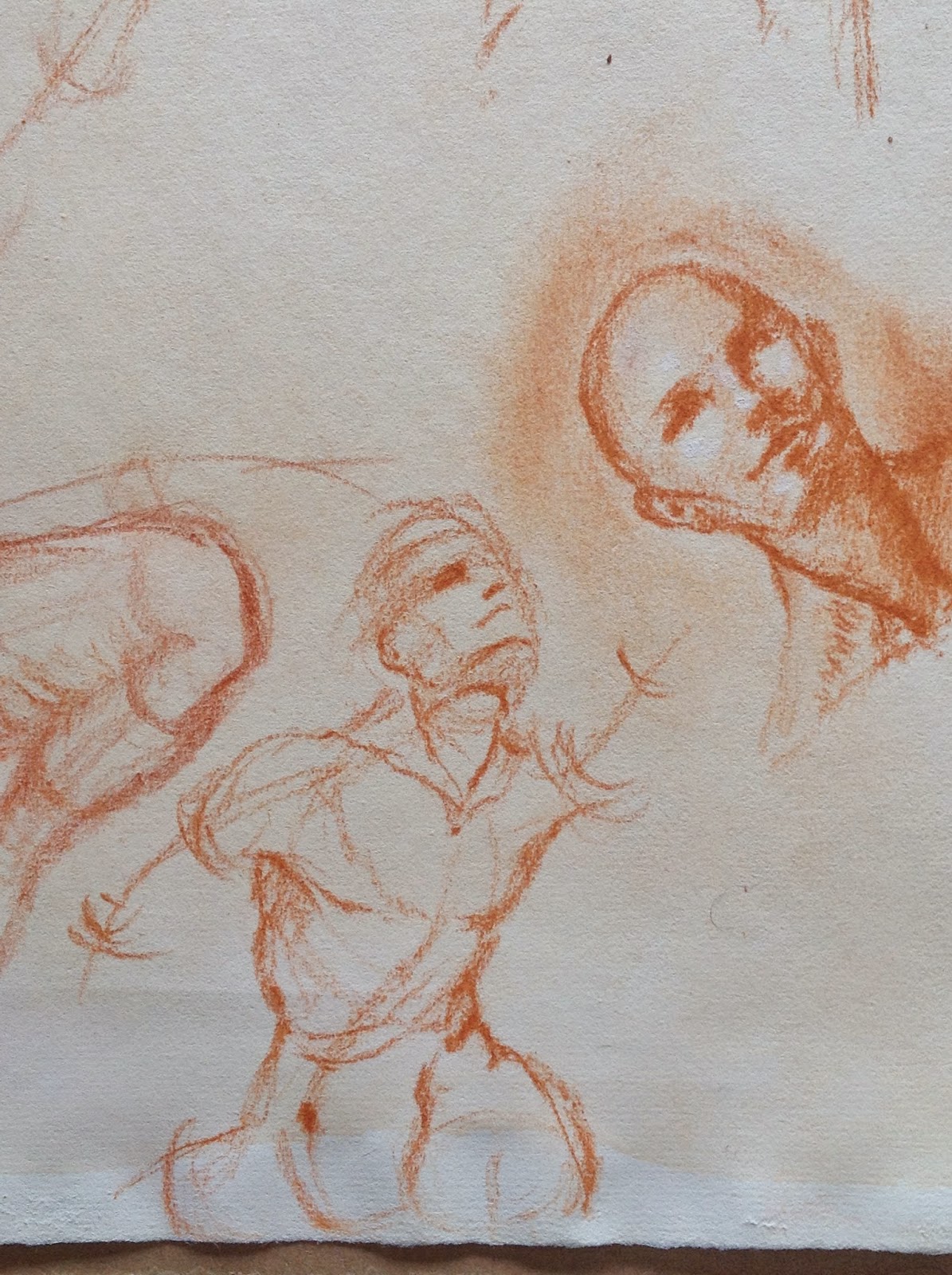
Michael Whynot. Sketch book page. red chalk.

Hand refined linseed oil.


Assorted, quick figure studies today, drawn from imagination. Trying to accomplish twelve things at once: I'm just getting to the end of Ernst Van De Wetering's book, Rembrandt: The Painter At Work, a great inquiry into the artist's Materials and working methods; getting my lines of the day down on paper; updating the blog; and learning the process of preparing my own linseed oil in preparation for making my oil paints.

Things are progressing, but it seems like there is so much to learn and so little time.

Thursday, 16 July 2015

Lines of the Day: July 16, 2015.

Michael Whynot. Figure study after Raphael. Red chalk.

Michael Whynot. Figure studies. Red chalk.

A quick study after Raphael Santi, at the top; a couple small, exploratory figures from imagination, at the bottom.

Thursday, 2 July 2015

Lines of the Day: July 2, 2015.

Michael Whynot. Figure study. Red chalk.

A thirty minute figure study, done this morning from imagination. Fitting form into form; trying to envision the foreshortening of the thigh and the manner in which it fits into the hip.

Monday, 22 June 2015

Lines of the Day: June 22, 2015.

Michael Whynot. Figure study. Red chalk.


A twenty minute figure study, done this morning. Remember to notice weight and balance, muscles in their relaxed state and in contraction: loose and long verses tight and shortened. Anatomy has many variables, so pay close attention. We often don't see that which we don't know. And those variations can elevate our drawing.

Sunday, 14 June 2015

Lines of the Day: June 14, 2015.

Michael Whynot. Figure study. Red chalk.

Today's lines were done over the last two days; ten minutes here, ten minutes there. Total time, maybe an hour. I'm not completely satisfied with it. It was done from imagination and I struggled with some of  the details. This is where a live model would have been helpful in sorting out areas which were anatomically unclear in my mind. For me this is usually the attitude of the limbs and problems with perspective. Still, not a total loss.

Sunday, 26 April 2015

Fear of Drawing Hands.

Michael Whynot. Hand study in red chalk.


Michael Whynot. Hand study in red chalk.


Michael Whynot. Hand study in red chalk.


Michael Whynot. Hand study in red chalk.


Michael Whynot. Hand study in red chalk.


Michael Whynot. Hand study in red chalk.


Michael Whynot. Hand study in red chalk.


One of the questions I hear, more than any other, is how do I draw hands? A lot of people harbour a deep fear of drawing hands. So much so, that many will avoid them altogether, hiding them behind something or cropping them off. Unfortunately, this is exactly the wrong way to learn anything.

Hands have a learnable structure, like any other form, albeit it somewhat more complex. Get a good anatomy book and study the skeletal structure; there is a wonderful sort of symmetry to the structure of the hand, and once you see it you will be able to place the parts with more precision.

Then you need to watch people's hands - a lot of people's hands. Watch them working, playing and resting. More than almost any other form, seeing the gesture in hands will mean the difference between a stiff, lifeless drawing and one that you can reach out and touch. When drawing hands, always start with the gesture.

You need to draw hands constantly to improve; your own hands, pictures of hands - take a whole life drawing session and just draw the hands. Make quick doodles, short studies, longer, carefully rendered studies. Eventually, you will loose your fear of them and they may actually become your favourite, expressive, body part to draw.

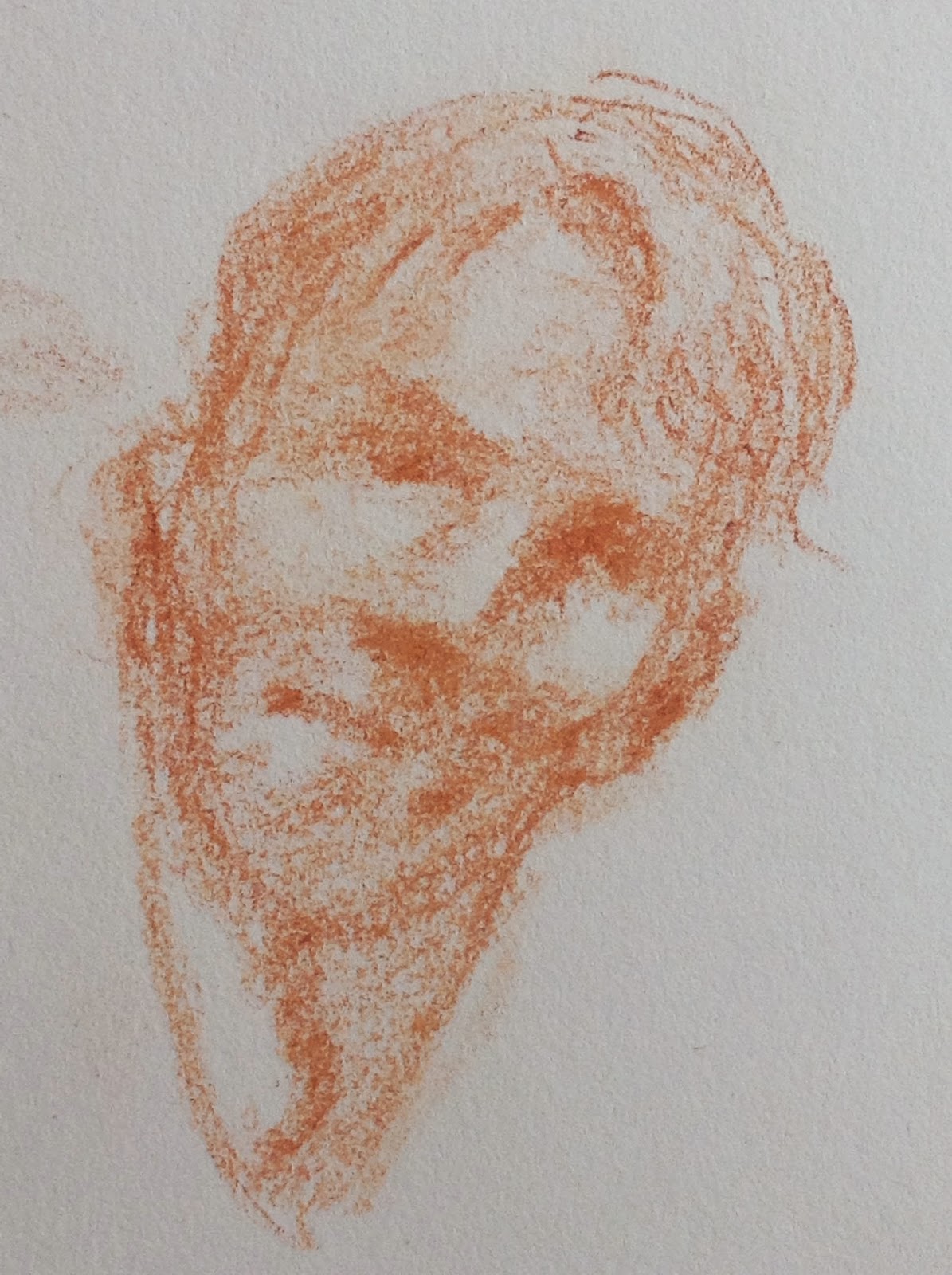
Study of Old Man with Beard.

Michael Whynot. Red chalk.


A fifteen minute study, done this morning in red chalk of an older man with a beard.

Tuesday, 14 April 2015

Light and Form.

Michael Whynot. Red chalk.


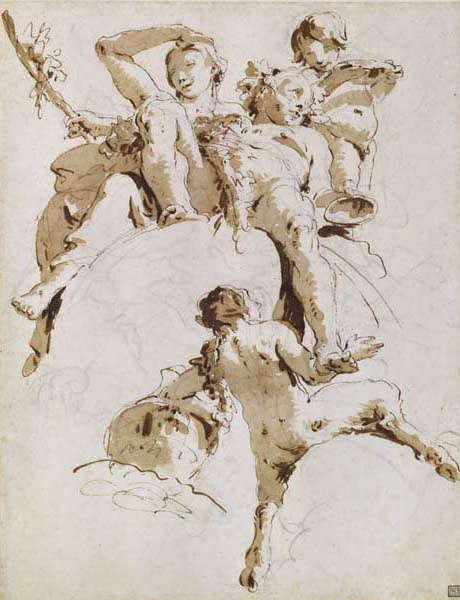
Tiepolo.


Tiepolo.


To depict the figure convincingly, one needs to understand how form is constructed and, also, how light will behave when interacting with the form.

Doing this with the live model, under well-lit conditions (a single light source), is the best way to study light. But once you have an understanding of light and form, you are free to create images from imagination and play with pose and composition.

The drawing, above, was done from imagination, last evening. It took about two hours from first gesture line to completion. There are so many aspects to consider when doing drawings like this from imagination, without the luxury of a model; like a juggler trying to juggle six balls, instead of three.

The two drawings below mine are by the Venetian painter Giovanni Battista Tiepolo (1696-1770). He was a master of light and form, and these pen and wash drawings show this master's complete understanding of both, and highlight how much work I have, yet, remaining.

Sunday, 12 April 2015

The Illusive Aspect of Movement.

Michael Whynot. Red chalk.

Michelangelo. Study for Hamen.


Here is a drawing done yesterday from imagination. I was trying to capture a sense of movement in the figure. This can be done with a live model, if you are very good at quick gestures, or with the use of supports for your model such as a rope or chair. But this is an area of drawing where the imagination shines. Literally, any pose you can imagine, can be drawn. Still, movement is difficult to depict (as it is when working from a live model). Stiffness always wants to creep in; overworking such a drawing can kill it. Often, any looseness you admired in your initial drawing disappears as you render. Less may be more in this instance.

Michelangelo called his sculpture viva - living. And this aspect can be seen in his drawings and paintings, as well. He strove for this sense of life; he considered this movement as one of the cornerstones of his art.

Monday, 6 April 2015

Red Chalk Drawing: Comparing Modern Alternatives with the Real Thing.

Michael Whynot. Red chalk.


Michael Whynot. Red chalk.

I am a big admirer of red chalk drawings from the renaissance. So much so, that it is my preferred drawing medium. But it's not as simple as that. The drawings made during the renaissance were actual red chalk, while what we usually draw with today are modern equivalents.

And they are not all created equal. There are red chalk-like alternatives made by Conte, Faber-Castell, and Prismacolor Verithins to name just three of the brands that I have tried personally. And they all have their faults and advantages.

Conte is very soft and makes achieving dark values easy. But I find that the binder used to bind the pigment is too oily and getting fine detail is difficult in smaller drawings.

The Prismacolor and Faber-Castell brands use a waxy binder that makes it easier to get fine details but hard to get a dark value.

I have started using natural sanguine recently, which is an actual red chalk that comes in chunks which need to be cut or sanded into a convenient shape for drawing.

The first drawing above was made with a Faber-Castell pencil and the bottom was made with real red chalk. The red chalk is much drier than any of the man-made pencils, but not as easy to work with. It tends to be inconsistent from one piece to another. Some can be very crumbly while others are too hard. But I like the feel of it, when you get a good chunk; it has a nice pull against the paper. And gaining a dark value is easy. Fine detail, though, is also difficult to achieve with smaller drawings.

It will take some getting used to, but the real red chalk gives a glowing aspect to a drawing that seems to be missing from the man-made alternative. I like its rich, vibrant warmth.

Wednesday, 25 March 2015

Beauty, Expressiveness and the Human Figure.

Michael Whynot. Figure Study. Red chalk.


The range of beauty and expressiveness possible within the attitude of the human figure never fails to leave me with a sense of wonder. The flesh is the veil through which we glimpse the soul.

Is it any wonder that the figure has been the focus of art since we first began to draw?

The drawing above began with a few quick gesture lines. I had a simple twist of the torso in mind when I set down with my drawing pad. I began to explore the figure on the paper, changing the gesture lines for the neck, arms and legs. The range of possibilities was nearly endless.

An hour later, I had this expressive figure on the page, the head lolling against the shoulder, knee thrusting forward, arms spread wide.

A person could spend a lifetime exploring all the possibilities of the figure and, I dare say, it would not be a life wasted.

Monday, 23 March 2015

The Advantage of Drawing from Imagination.

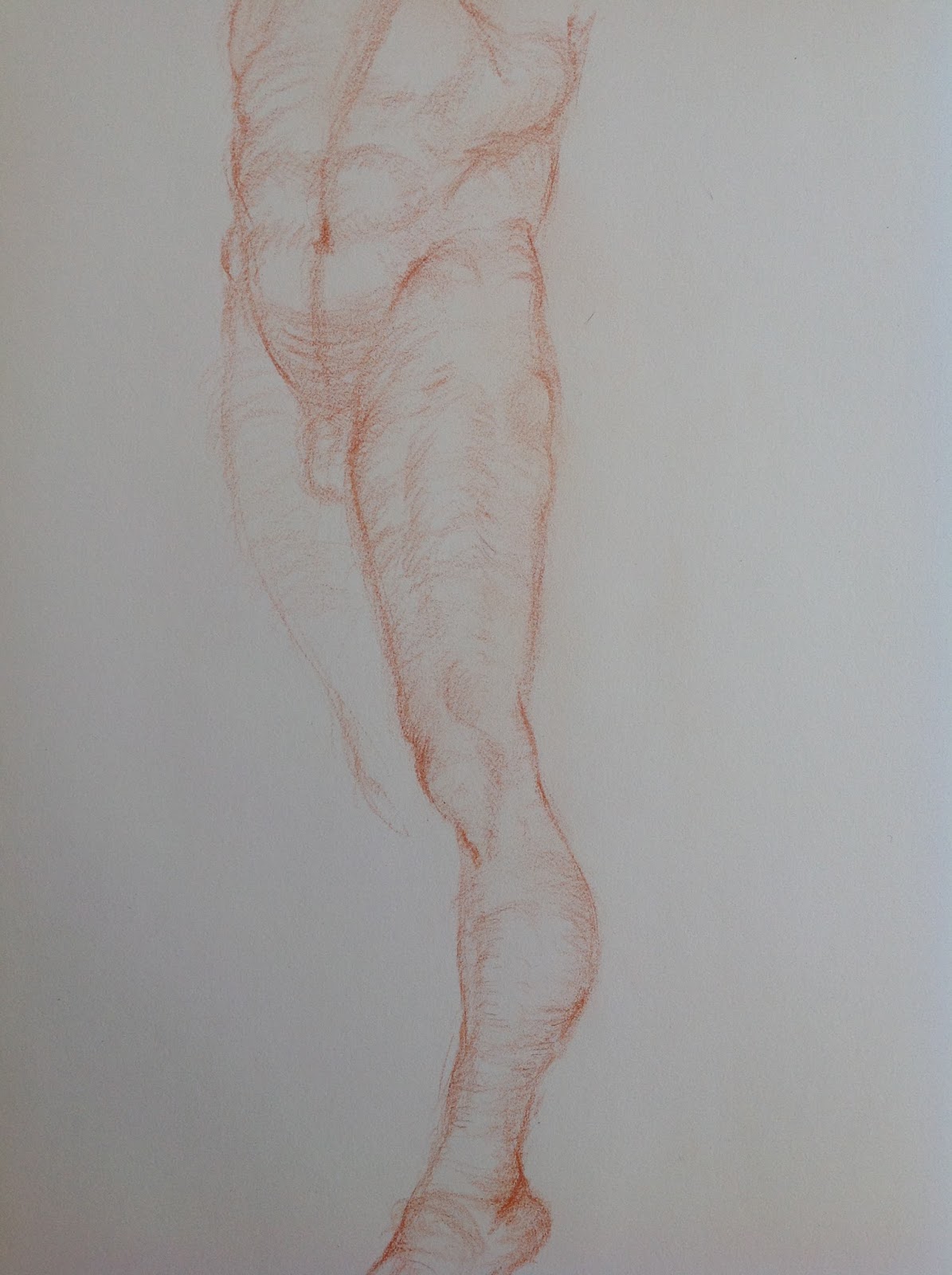
Michael Whynot. Leg study. Red chalk.


I am posting a leg study done this morning in red chalk. Once again, this was done from imagination. I have been away from drawing the live model for some time now, but I am finding that I still retain my basic understanding of the human form and how it is constructed. I will soon go back to the live model to make sure that I am not missing the many nuances that go hand in hand with changes in viewpoint, lighting and individual body shapes.

I believe this ability to draw from imagination is a necessity if an artist wants to move on from portraiture to multiple figure works, where having live models pose for the composition could be daunting. Drawing from imagination allows us the freedom to explore themes and poses before committing to live models to capture nuance.

The human form offers incredible possibilities in terms of its movement and multiple figures make these possibilities nearly infinite. Imagination allows us to explore these infinite variables of composition. In short, the ability to draw from imagination is the key to the creative process.

Wednesday, 18 March 2015

Snow Day Drawings

Michael Whynot. Red chalk gesture drawings.

Detail.


Detail.


We received a huge amount of snow here, last night and this morning; spring can't get here soon enough.

On the bright side, it gave me an hour to play around with some  rough gesture drawings, exploring different poses for the figure. This is where you can give your drawing free rein without the constraints of drawing directly from life. And it's a lot of fun.

Saturday, 7 March 2015

Upon Closer Examination: Drawing and the Beauty in the Details.

Michael Whynot. Figure study. Red chalk.


Michael. Detail.


Michael Whynot. Head study. Red chalk.


Michael Whynot. Detail.


Michelangelo. Head of a Young Man  C. 1516.


Michelangelo. Detail.


There is something wondrous about drawing: this ability to illuminate the three dimensional world of forms upon a two dimensional medium - light where there is no light, shade where there is no shade, and form where there is no form. Simply amazing.

And, as beautiful as drawings are, we can often be so beguiled by the illusion of three dimensions where there are only two, that we fail to examine, closely, the actual marks themselves that created the illusion. And in so doing, I would argue that we miss the beauty inherent in the details themselves.

The lines of a drawing reveal themselves not merely as the edges of forms, but serve to describe form beautifully as they travel over the surface, creating patterns as they bunch up and spread out, flowing in one direction and then another.

If you truly wish to appreciate a good drawing, and draw better yourself, don't be content with studying the big picture; examine the details and you may come away with a better understanding of the drawing and the wondrous illusion it creates.

Wednesday, 25 February 2015

The Sum of the Parts.

Michael Whynot. Figure study. Red chalk.


Michael Whynot. Foot study. Red chalk.


Michael Whynot. Hand study. Red chalk.


Aristotle wrote that: "The whole is greater than the sum of its parts." And, while this is certainly true of the human form, where the inherent flow of gesture from one body part to the next can create a grace and emotional connection more profound than the summation of the individual pieces, I would argue that the individual forms, when studied in isolation, can convey a grace and beauty all their own.

There is no question of the wondrous flow of gesture through the legs, hips and torso above, yet, if you study the arm or the leg and the attached hand or foot, taken in isolation, you will find the same ebb and flow through these parts as well.

The organic form is a wonder of engineering, evolution, or creation (whichever term you prefer). It has captivated our souls and our art since we first made marks upon the walls of dimly lit caves and it continues to captivate us today. The fact that such continuity of form, that flowing gesture of grace, is evident no matter how small a piece of the whole we observe, speaks to the profound truth of Aristotle's quote. The whole is, indeed, greater than the sum of its parts, which is greater than the sum of its parts, which is greater than the sum of its parts… ad infinitum.

Sunday, 22 February 2015

A Mind for Figures.

Michael Whynot. Figure study. Red chalk.


Michael Whynot. Figure study. Red chalk.


This is my first post in over a year. I must admit to having these recurring bouts of fatigue and self-doubt. Doubt in my ability, my goals, and my own will to accomplish them. On such days, I feel that nothing I create is of any worth and that I have progressed as far as I am able to. These are the times when I find it much easier to become side-tracked, by my other diverse interests, than to draw. It's like watching a baseball being thrown at your head, but being unable to step out of harms way.

I am trying to get back on track, though, with this new post and these two drawings from imagination. The human figure occupies my mind constantly and drawing seems to be the only way to release them.

Aristotle said: "We are what we repeatedly do. Excellence, therefore, is not an act but a habit."
So, I will attempt to get back into the habit of drawing regularly every day. Wish me luck and, if you like these figure studies, please share your thoughts.

Monday, 21 October 2013

The Nature of Beauty.

Michael Whynot. Portrait Study, 2013. Red chalk.


Michael Whynot. Portrait Study, 2013. Red chalk.


What beauty is, I know not, though it adheres to many things. (Albrecht Durer)


I have begun to question the nature of beauty - and what, exactly, I am observing when I see that which I perceive as beautiful.

Is beauty intrinsic in an object or is beauty a quality of a perceptive mind?

Beauty must be subjective, as evidenced by the wide range of what is accepted as beautiful. But, it seems to me, that subjective beauty is mostly cosmetic; mere surface appearance. If we can get past our conceptions of what we believe beauty to be, and allow perception to be immediate and unencumbered by thought, then beauty may show itself to be universal and self-evident; a quality as real as truth or goodness.

Friday, 26 July 2013

Portrait Study from Life

Michael Whynot. Portrait study of Anne-Marie. Red chalk with white highlights, 2013.


Posting a short (fifteen minutes) study from last night's life session. I often wonder how much of an effect time has on our work? The fifteen minutes available for this study allowed for little more than a block-in with a couple of highlights to add dimensionality. Where would another fifteen minutes have led? Another thirty? An opportunity for improvement, or a chance to spoil the whole thing? I lie in bed at night and wonder about such alternatives: opportunities lost or blessings in another guise.