Showing posts with label figure drawing.. Show all posts

Monday, 5 October 2015

Lines of the Day: October 5, 2015.

Michael Whynot. Figure studies. Red chalk.


A page from my sketch book that I did this morning. Just an exploration of assorted anatomy. I imagine them in three dimensions: forms, upon forms, upon forms. If you are drawing an exterior contour line with no relation to the forms from which that line is comprised, your drawing will be stiff, lifeless and two dimensional.

Monday, 22 June 2015

Lines of the Day: June 22, 2015.

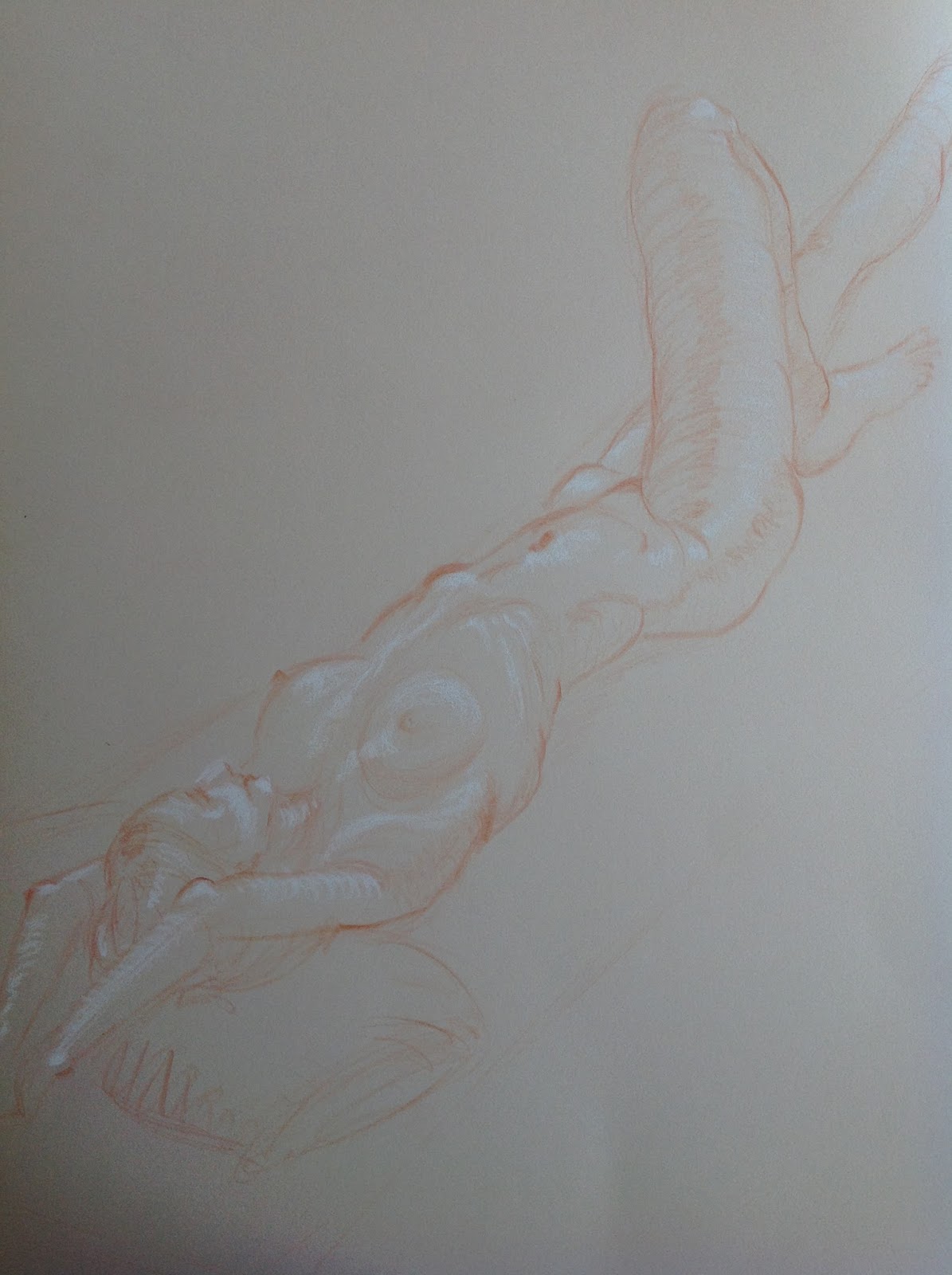
Michael Whynot. Figure study. Red chalk.


A twenty minute figure study, done this morning. Remember to notice weight and balance, muscles in their relaxed state and in contraction: loose and long verses tight and shortened. Anatomy has many variables, so pay close attention. We often don't see that which we don't know. And those variations can elevate our drawing.

Monday, 8 June 2015

Lines of the Day: June 8, 2015

Michael Whynot. Figure study. Red chalk.


Michael Whynot. Figure study. Red chalk.

Today's lines: exploring variations of a particular pose.

Monday, 1 June 2015

The Evolution of Seeing.

Michael Whynot. Anatomy study. Red chalk.


Michelangelo said: "It is necessary to keep one's compass in one's eyes and not in the hand, for the hands execute, but the eye judges."

Learning to draw, making our marks on paper, shouldn't be such a difficult thing - children do it all the time and we were all children once. And yet, drawing well turns out to be a deceptively difficult skill; few ever truly master it.

Of course, the difficulty isn't so much making the mark, as knowing where, when and why to make the mark or not. And, to answer those questions, one must cultivate the ability to see form in three dimensions.

Many draftsmen conquer height and width, which can be measured mechanically with due practice. But depth is more illusive - perspective, atmosphere, foreshortening all come into play. And this is where mechanical measuring tends to falter, resulting in accurate, flat, lifeless drawings. Training the eye to see all the nuences of form can take a lifetime, but the results are worth it.

In the end, learning to draw, may be more a question of learning to see.

Monday, 23 March 2015

The Advantage of Drawing from Imagination.

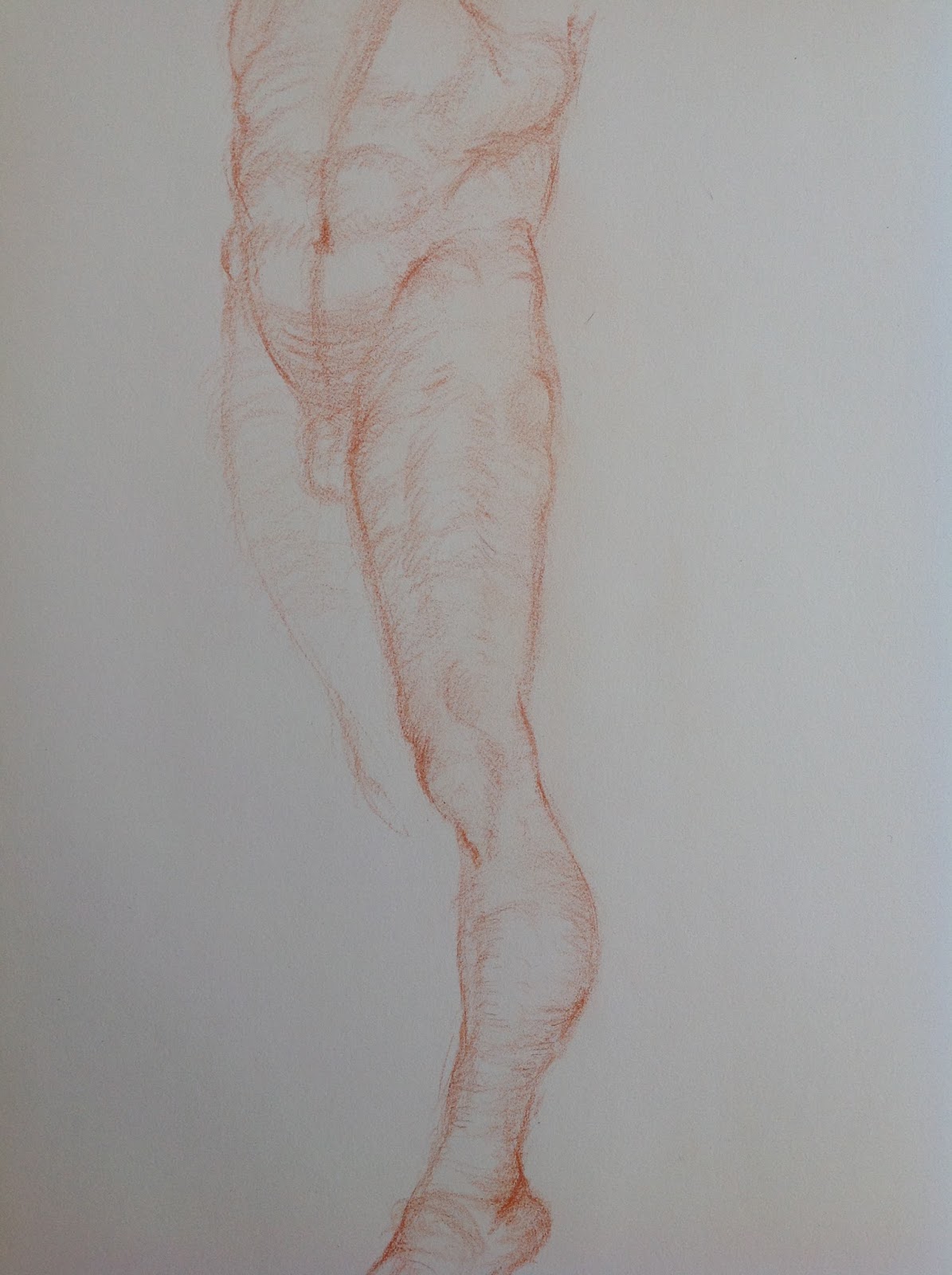
Michael Whynot. Leg study. Red chalk.


I am posting a leg study done this morning in red chalk. Once again, this was done from imagination. I have been away from drawing the live model for some time now, but I am finding that I still retain my basic understanding of the human form and how it is constructed. I will soon go back to the live model to make sure that I am not missing the many nuances that go hand in hand with changes in viewpoint, lighting and individual body shapes.

I believe this ability to draw from imagination is a necessity if an artist wants to move on from portraiture to multiple figure works, where having live models pose for the composition could be daunting. Drawing from imagination allows us the freedom to explore themes and poses before committing to live models to capture nuance.

The human form offers incredible possibilities in terms of its movement and multiple figures make these possibilities nearly infinite. Imagination allows us to explore these infinite variables of composition. In short, the ability to draw from imagination is the key to the creative process.

Saturday, 7 March 2015

Upon Closer Examination: Drawing and the Beauty in the Details.

Michael Whynot. Figure study. Red chalk.


Michael. Detail.


Michael Whynot. Head study. Red chalk.


Michael Whynot. Detail.


Michelangelo. Head of a Young Man  C. 1516.


Michelangelo. Detail.


There is something wondrous about drawing: this ability to illuminate the three dimensional world of forms upon a two dimensional medium - light where there is no light, shade where there is no shade, and form where there is no form. Simply amazing.

And, as beautiful as drawings are, we can often be so beguiled by the illusion of three dimensions where there are only two, that we fail to examine, closely, the actual marks themselves that created the illusion. And in so doing, I would argue that we miss the beauty inherent in the details themselves.

The lines of a drawing reveal themselves not merely as the edges of forms, but serve to describe form beautifully as they travel over the surface, creating patterns as they bunch up and spread out, flowing in one direction and then another.

If you truly wish to appreciate a good drawing, and draw better yourself, don't be content with studying the big picture; examine the details and you may come away with a better understanding of the drawing and the wondrous illusion it creates.

Sunday, 7 April 2013

Drawn to Grace.

Michael Whynot. Figure Study, 2013. Red chalk.


Michael Whynot. Figure Study, 2013. Red chalk.


Michael Whynot. Figure Study, 2013. Red chalk.

Michael Whynot. Figure Study, 2013. Red chalk.


Michael Whynot. Figure Study, 2013. Red chalk.


She Walks in Beauty

                                                                         BY LORD BYRON (GEORGE GORDON)
She walks in beauty, like the night
   Of cloudless climes and starry skies;
And all that’s best of dark and bright
   Meet in her aspect and her eyes;


    I know grace when I see it. Defining grace, however, is somewhat more difficult, although Merriam-Webster defines it, at least for our purposes, as: ease and suppleness of movement or bearing...

    Ease and suppleness of movement or bearing. As I stated, above, I know it when I see it, but explaining why, exactly, one person has it, while another does not, eludes me. Grace can mean the difference between an adequate drawing and a great drawing. Grace of form has the power to inspire us and can elevate our drawing with its mere presence.

    I yearn for this trait in the models I draw. I believe that, for the most part, models may not understand this trait or even recognize it in themselves. Grace is something which comes naturally and I am uncertain whether it can be nurtured or not.

    I believe that Lord Byron was describing grace in his beautiful poem:

                                                She walks in beauty, like the night
   Of cloudless climes and starry skies;
And all that’s best of dark and bright
   Meet in her aspect and her eyes;
    
    Meet in her aspect and her eyes. If we, as draftsmen, can but capture this elusive aspect in our drawings, they will be, unquestionably, the better for it. But seeing grace is the precursor to drawing grace. So, perhaps, grace must be present in both artist and model. Perhaps grace is what we, as artist, see.