Showing posts with label drawing from imagination. Show all posts

Monday, 27 April 2015

Imagination: the Artist's Infinite Resource.

Michael Whynot. Figure study in red chalk.


Michael Whynot. Figure study in red chalk.


I have written several times that the ability to draw from imagination is indispensable to the artist, but I would like to emphasize the point once again. The imagination is an infinite resource and once the artist learns to draw from it, vast compositional possibilities open up for us.

Imagine any scenario you can; from battle, religious, historical to fantasy themes. Now picture that scene in your mind's eye: what are the figures doing, where is the light coming from? Then what if you could draw, paint or sculpt that scene that you just imagined? Setting up multiple models and all the required props is possible, but could be a major undertaking of both money and time, depending on the complexity of your vision.

Michelangelo undertook a vast project when he agreed to paint the ceiling of the Sistine Chapel, and he surely used models to help refine some of the poses, but the concept and the majority of the work was made possible by his wondrous ability to draw the human form from his imagination.

The two drawings, above, were drawn today from my imagination. As I endeavour to perfect this faculty, I can see an incredible range of compositional and narrative roads leading in every direction. I'm not sure how far down those roads my ability will allow me to travel, but it promises to be an interesting journey.

Tuesday, 14 April 2015

Light and Form.

Michael Whynot. Red chalk.


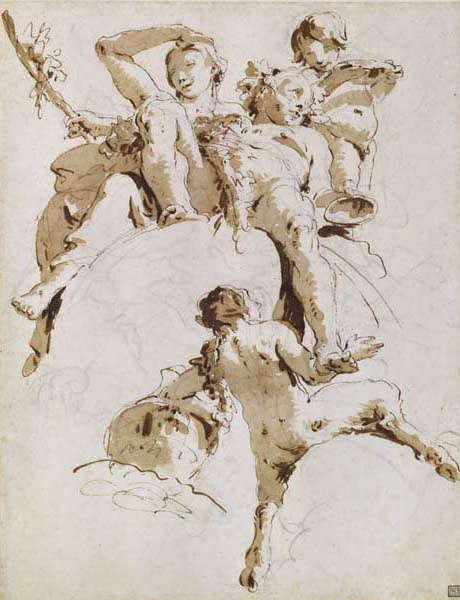
Tiepolo.


Tiepolo.


To depict the figure convincingly, one needs to understand how form is constructed and, also, how light will behave when interacting with the form.

Doing this with the live model, under well-lit conditions (a single light source), is the best way to study light. But once you have an understanding of light and form, you are free to create images from imagination and play with pose and composition.

The drawing, above, was done from imagination, last evening. It took about two hours from first gesture line to completion. There are so many aspects to consider when doing drawings like this from imagination, without the luxury of a model; like a juggler trying to juggle six balls, instead of three.

The two drawings below mine are by the Venetian painter Giovanni Battista Tiepolo (1696-1770). He was a master of light and form, and these pen and wash drawings show this master's complete understanding of both, and highlight how much work I have, yet, remaining.

Monday, 23 March 2015

The Advantage of Drawing from Imagination.

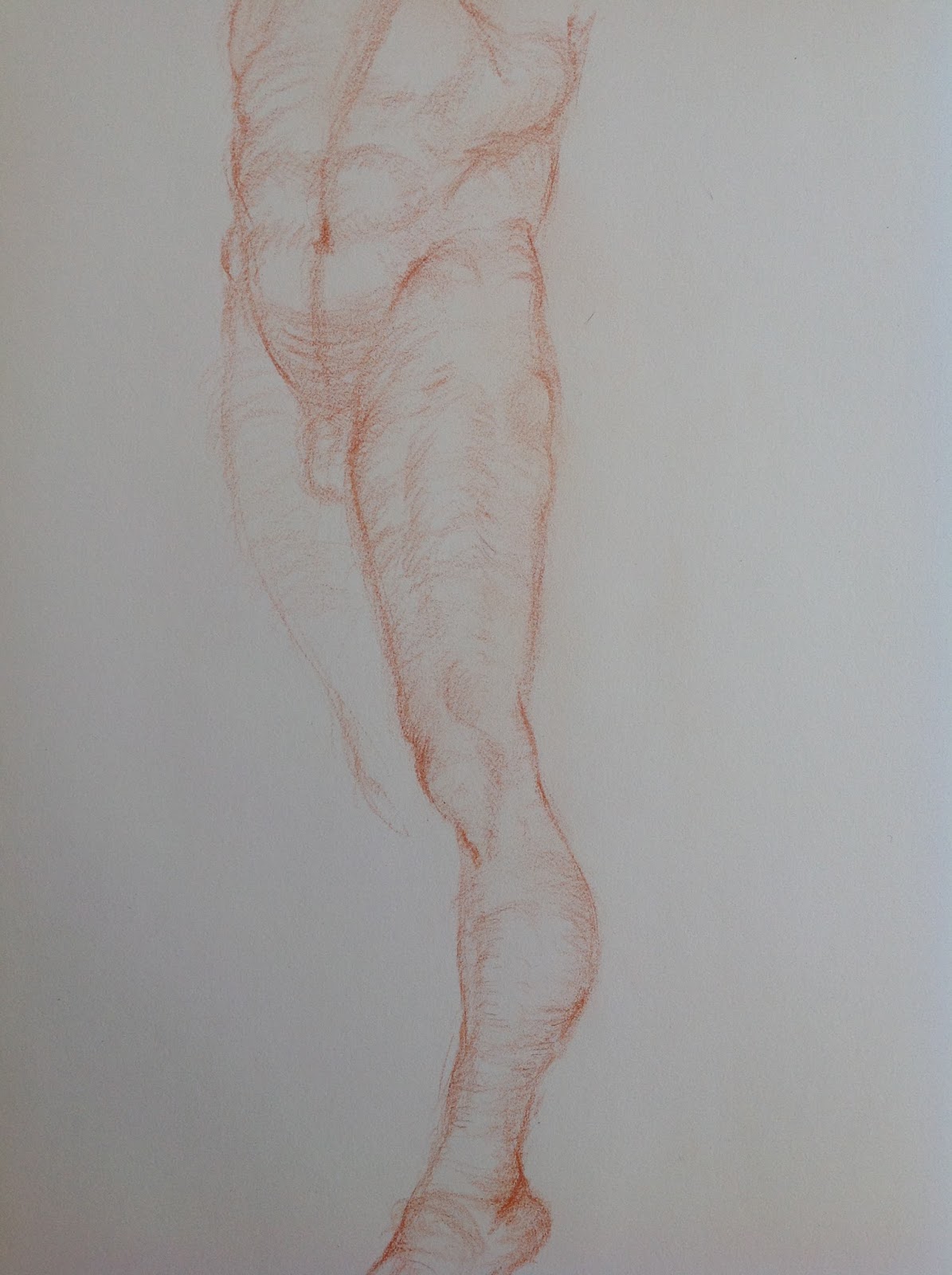
Michael Whynot. Leg study. Red chalk.


I am posting a leg study done this morning in red chalk. Once again, this was done from imagination. I have been away from drawing the live model for some time now, but I am finding that I still retain my basic understanding of the human form and how it is constructed. I will soon go back to the live model to make sure that I am not missing the many nuances that go hand in hand with changes in viewpoint, lighting and individual body shapes.

I believe this ability to draw from imagination is a necessity if an artist wants to move on from portraiture to multiple figure works, where having live models pose for the composition could be daunting. Drawing from imagination allows us the freedom to explore themes and poses before committing to live models to capture nuance.

The human form offers incredible possibilities in terms of its movement and multiple figures make these possibilities nearly infinite. Imagination allows us to explore these infinite variables of composition. In short, the ability to draw from imagination is the key to the creative process.

Wednesday, 18 March 2015

Snow Day Drawings

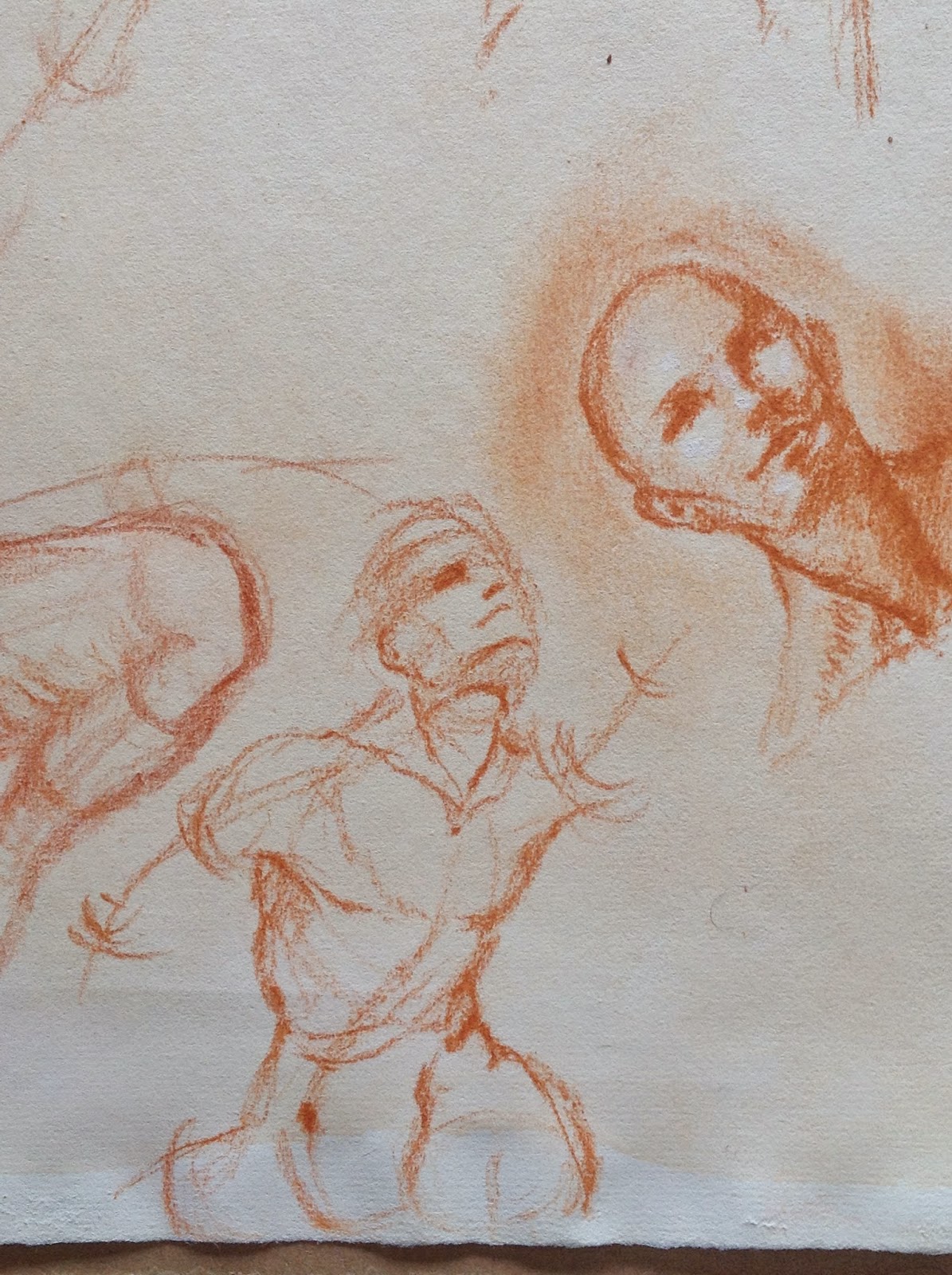
Michael Whynot. Red chalk gesture drawings.

Detail.


Detail.


We received a huge amount of snow here, last night and this morning; spring can't get here soon enough.

On the bright side, it gave me an hour to play around with some  rough gesture drawings, exploring different poses for the figure. This is where you can give your drawing free rein without the constraints of drawing directly from life. And it's a lot of fun.

Saturday, 6 July 2013

Drawing Upon Imagination.

Michael Whynot. Study of male reaching. Red chalk, 2013.


To 'draw' implies everything the word stands for: to pull or to drag or or to draw forth, as from the earth, a vein, or well.   (Lance Esplund)


Where are ideas born; from whence does inspiration spring? The imagination is little understood, but would seem to be a distillation of the remembered experiences of our lives. Hence, the infinite variety and scope of individual creativity.

Drawing is the ideal way of exploring the imagination: pulling new ideas to the surface, examining unfamiliar pieces of a puzzle until they fall into place. Da Vinci, Michelangelo, Pontormo; they all understood the link between drawing and the imagination, though its source remained mysterious to them - divine.

The drawing, above, was done this morning from imagination, and, like those masters five hundred years ago, I, too, have no conception of how it arose.

There are so many ways that a drawing can fail, that I am led to contemplate the hand of God in my work - the minor miracle exposed - when I actually succeed.

Thursday, 4 July 2013

Recreating Form: The Role of Conception in Drawing.

Michael Whynot. Male figure seen from behind, 2013. Red chalk.


What is art but life upon the larger scale, the higher. When, graduating up in a spiral line of still expanding and ascending gyres, it pushes toward the intense significance of all things, hungry for the infinite.              (Elizabeth Barrett Browning)


I am posting a study done last evening. The gesture is very subtle; weight resting on one leg, a nearly imperceptible twist of the spine. The angle of the wrist seemed curious to me, questioning something. We bring much of ourselves to the work we create. In truth, it is our conception of what we see that sets our best work apart from work where we simply copy what we see.

My goal is to not copy nature, but to recreate nature as I see it; the grace and splendor possible in the human form. This is the where a personal style emerges.

Who could argue that Michelangelo did not recreated everything he drew, painted or sculpted. His forms are idealized, conceived to fulfill a purpose; his purpose. Why is it that his work is so revered? Were his proportions more accurate, his modeling of form more realistic?

No. It was that his conception was more vivid, his imagination more divine. He saw form in a manner which others could not and he had the skill to render that conception in chalk, paint and stone, so that others could see what he saw: wonders.

So I will continue along the path of recreating form, nurturing imagination and conception, searching for the ideal.

Thursday, 16 May 2013

Never A Day Without A Line: Deliberate Practice and Figure drawing, Part 1.

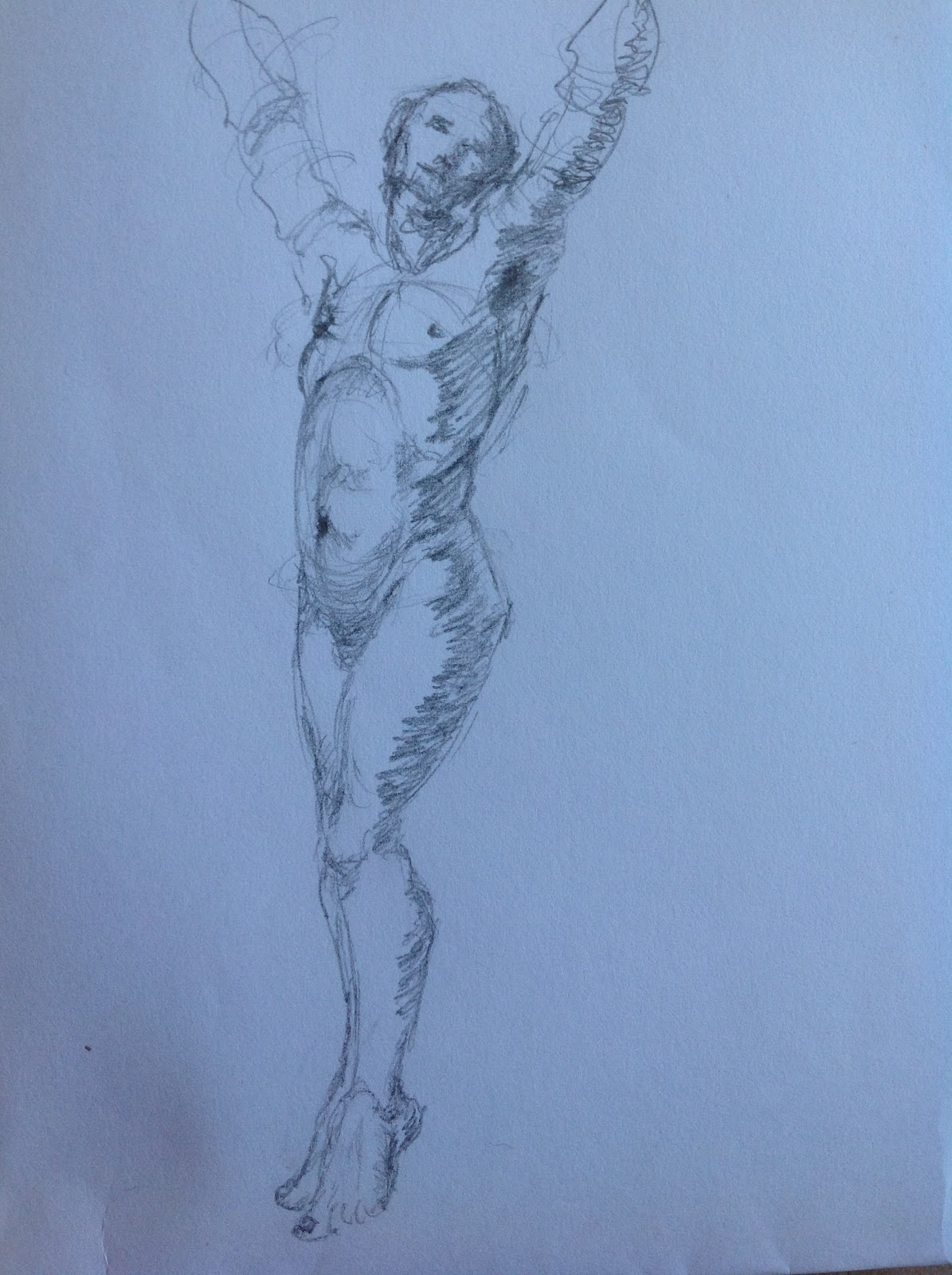
Michael Whynot. Figure Study, 2013. Graphite.


Michael Whynot. Figure Study, 2012. Ink.

Michael Whynot. Figure Study, 2013. Ink.


Michael Whynot. Figure Study, 2012. Ink.


Michael Whynot. Portrait Study, 2013. Ink.

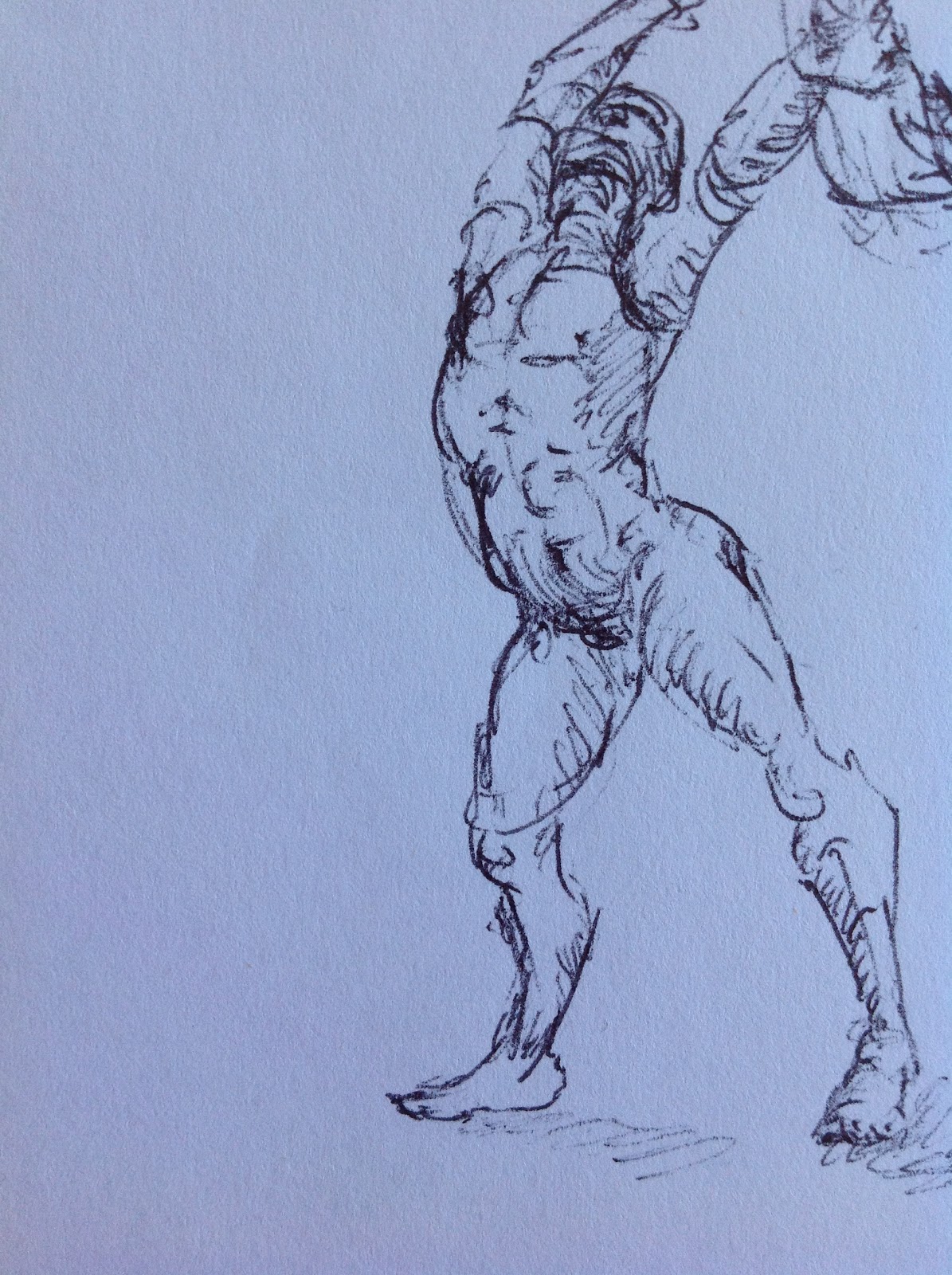
Just posting a few figure studies done, in spare moments, from imagination and a quick portrait study done from life. All these drawings are quick and small (1 to 3 inches). I do try to draw something every day, without exception.

I believe that the ability to draw well hinges on the ability to see form in a certain way. Seeing form in this way is neither intuitive nor particularly common, but it is a learnable skill and once you do see in this manner, it is difficult to see in any other way. Drawing becomes an exploration of form in space and not merely random doodling. So, practicing every day is the means through which we improve our drawing ability only when we practice deliberately, with purpose. Drawing must never be done absently if we are to improve. Good drawing demands that the artist be present.

Monday, 15 April 2013

Male Torso Study In Motion.

Michael Whynot. Male torso study in motion, 2013. Red chalk.


Drawing the human form in motion can be challenging. The figure above was drawn in fifteen minutes from imagination. A convincing rendering needs to take many things into consideration: gesture, point of view, light source, anatomy. These can all be set up in the studio with a model and props to help them maintain the pose, but it is expensive, both in terms of time and money. For initial studies, drawing from imagination can be the best option. Anatomy, light and shadow can be refined with the aid of a model after you actually have something.

I believe that creativity can wither with disuse. Too much copying of nature can be as detrimental as not enough. The artist must balance the two. Use your imagination daily; allow creativity to grow.