Showing posts with label gesture drawing. Show all posts

Wednesday, 18 March 2015

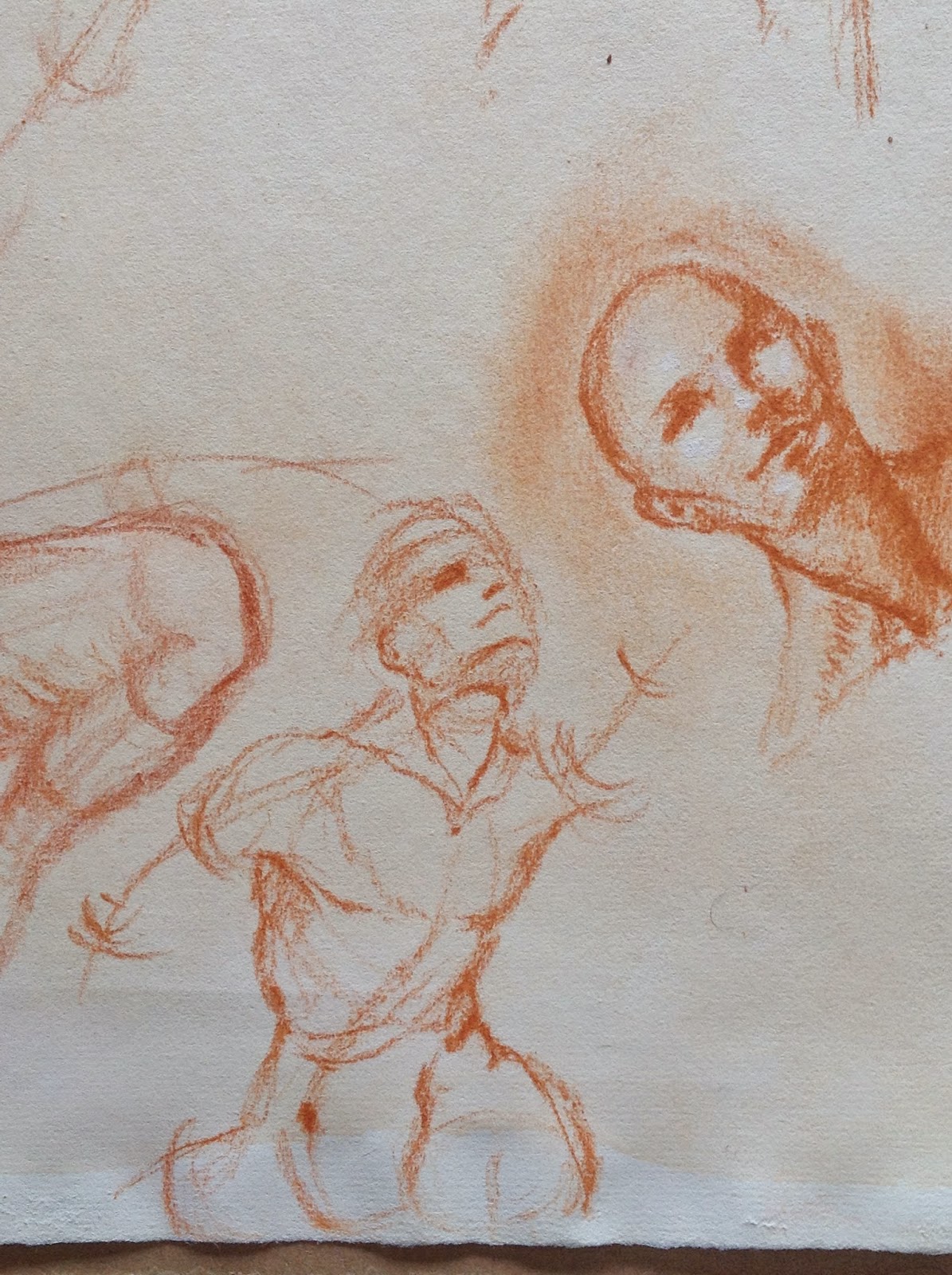
Snow Day Drawings

Michael Whynot. Red chalk gesture drawings.

Detail.


Detail.


We received a huge amount of snow here, last night and this morning; spring can't get here soon enough.

On the bright side, it gave me an hour to play around with some  rough gesture drawings, exploring different poses for the figure. This is where you can give your drawing free rein without the constraints of drawing directly from life. And it's a lot of fun.

Wednesday, 25 February 2015

The Sum of the Parts.

Michael Whynot. Figure study. Red chalk.


Michael Whynot. Foot study. Red chalk.


Michael Whynot. Hand study. Red chalk.


Aristotle wrote that: "The whole is greater than the sum of its parts." And, while this is certainly true of the human form, where the inherent flow of gesture from one body part to the next can create a grace and emotional connection more profound than the summation of the individual pieces, I would argue that the individual forms, when studied in isolation, can convey a grace and beauty all their own.

There is no question of the wondrous flow of gesture through the legs, hips and torso above, yet, if you study the arm or the leg and the attached hand or foot, taken in isolation, you will find the same ebb and flow through these parts as well.

The organic form is a wonder of engineering, evolution, or creation (whichever term you prefer). It has captivated our souls and our art since we first made marks upon the walls of dimly lit caves and it continues to captivate us today. The fact that such continuity of form, that flowing gesture of grace, is evident no matter how small a piece of the whole we observe, speaks to the profound truth of Aristotle's quote. The whole is, indeed, greater than the sum of its parts, which is greater than the sum of its parts, which is greater than the sum of its parts… ad infinitum.

Sunday, 30 June 2013

The Lure of Anatomy: Part 2.

Michael Whynot. Study of Arms At Rest and in Tension, 2013. Red chalk.


Michelangelo. Study for Haman.

Raphael. Study for the Massacre of the Innocents. 

Rembrandt. Seated Old Man in Armchair.


Today I had a question from one of the newer readers of this blog, asking if I had any tips on drawing muscles.

In a previous post (The Lure of Anatomy), I discussed, at length, when and why I believed that the study of anatomy is most beneficial to a new draftsman.

Muscles are no different than any other form: the better you understand the form, the better you will draw it. And the more frequently you draw it, the better you will understand it. It is a cyclically beneficial method of learning: drawing leads to understanding, understanding leads to better drawing, which leads to better understanding...(See my previous post on The Act of Drawing Well).

Having said that - drawing muscles well, like any other form, is best accomplished with a multi-pronged approach.

Draw from the live model as frequently as possible - there is no substitute to drawing from life. But understand that the amount of information on the live model will be immense and confusing for the new draftsman. And complicating the process will be colour, value, poor lighting, etc.

A good anatomy book will prove indispensable. It will help you to understand the confusing wealth of information on the live model.

Drawing from (i.e. copying- it is not a bad thing) master drawings. This is one of the most beneficial exercises that the new draftsman can practice. Artists throughout history have been doing it. It is how we learn to see what they saw - which elements they emphasized, which elements they downplayed or eliminated, altogether. Learn from Michelangelo, Raphael, Da Vinci and Rembrandt - there are no finer teachers, so utilize them.

In regards to drawing muscles, per se - they are rendered the same as any other form: they are three dimensional volumes with a width, height and depth and should be drawn as such. But remember that muscles change their appearance constantly, so simple recipes for drawing them are mostly useless.

I have included a study of two arms to illustrate the difficultly of drawing muscles. Remember, a muscle at rest is shaped differently than the same muscle in tension. Note in my study, that Biceps Brachii, in the arm at rest, is longer and flatter, while in the arm in tension, it is shorter and higher. This is the nature of muscles and applies to every one of them.

Orientation of the muscle in space will also affect how we draw them: look at your own biceps, from above, and then rotate to view it from the side - a totally different shape and relationship to the surrounding forms.

There is no easy way to learn to draw the human form. Study from life and from reference and, from that point on, it's all repetition, repetition, repetition.

And, a final point: anatomy should never be the embarking point for the draftsman. Gesture is the most important, and often neglected, element in drawing. Note, in the beautiful studies above, that the anatomy is wondrous in all three, but prominent in the Michelangelo and Raphael drawings, while, in Rembrandt's drawing, it is mostly hidden beneath drapery - but gesture is the foundation upon which all the other elements are built.

Anatomy is beautiful, in and of itself, but gesture conveys the life of a drawing: neglect it at your peril.

Sunday, 28 April 2013

Foundation, Foundation, Foundation.

Michael Whynot. Figure Study, 2013. Red chalk with white highlights.


Michael Whynot. Thirty second?? gesture drawing, 2013.


I had someone comment this morning, during our life drawing session, that they liked my use of anatomy. And there is nothing more wonderful than to have our work appreciated.

But, while I do study anatomy, and its accurate portrayal greatly enhances our drawings, I worry that, often, anatomy is the only aspect of a good drawing that gets noticed. Unless the draftsman works from a strong gestural foundation, all the accurate anatomy, tone, etc. which they use later on, will be for nothing. Just as a carpenter would never attempt to shingle a roof before pouring the foundation for a house, so the draftsman must have their gesture solid before they worry about anatomy.

Shown, above, is a thirty second gesture from this morning's session and, above that, a thirty minute study completed, this afternoon, from that initial gesture. Notice that there is very little in the way of anatomy in the gesture; just the thrust of the forms, the tilt of the head, the twist of the torso. But it was all the information which was absolutely necessary to complete the final drawing. The pose is what was important; the natural rhythm that flows through a gesture is what makes our drawings come alive. Gesture animates anatomy not the other way around. If you build a drawing with anatomy as your foundation, you will find your drawings stiff and two dimensional; a lifeless endeavour. Concentrate on the gesture first; give it as much study as anatomy, or more. Life is what the viewer really sees in a good drawing, even if they don't realize it.

Wednesday, 20 March 2013

Gesture and Creativity.

Leonardo Da Vinci. Study of battles on horseback and on foot.


Leonardo Da Vinci. Study of battles on horseback and on foot.


Leonardo Da Vinci. Group of riders in the Battle of Anghiari.


Leonardo Da Vinci. Study for the Burlington House cartoon.


Michael Whynot. Gesture Study, 2013.


Michael Whynot. Gesture Study, 2013.


In my last post, I talked about the neglected skill of capturing gesture from life as a foundation for future work. Today, I would like to take gesture one step further and discuss its role in the creative process.

Once the draftsman has a solid grasp on capturing gesture from life, it is a short leap to begin exploring gestures from your imagination. Complex and multi-figure compositions do not always lend themselves to life studies (although individual figures, within the total composition, may do so). The initial design of the composition must emerge from the imagination and is best explored through gesture (see my previous post on nature versus imagination).

Leonardo Da Vinci was a genius, by an standards, and was famous for his use of this brainstorming technique. There are many surviving sheets of his rapid sketches which offer primi pensieri (first ideas) for many of his complex compositions.

I have included three sheets of his battle studies and one study for his Burlington House cartoon. Notice that these are in no way finished drawings - simply quick, explorations of his thoughts made visible on paper.

I have also included two sheets of my own gestures done, this morning, from imagination. They are very loose, done in under 20 seconds per figure. The draftsman should play with them; move them around in space and follow where they lead.

Although the source of creativity is mysterious and complex, drawing appears to focus, direct and enhance this process.

Monday, 18 March 2013

Gesture as Foundation.

Michael Whynot. Figure Study, 2013. Red chalk.


Michael Whynot. Gesture for the drawing above.


Michael Whynot. Head Study, 2013. Red chalk.


I'm posting some recent drawings today and I'm going to talk a little about gesture. Gesture is, perhaps, the most neglected of all the fundamental skills a draftsman requires. This may be owing to the fact that it is so deceptively simple. We're basically talking about a stick figure. And any four-year-old can draw these; or so it would seem. And, therein, lies the difficulty. A well done gesture captures the rhythm of the figure (see my previous post on gesture). Within it should be contained all the necessary information needed to complete a figure which is the thrust of the forms; the pose. Once you have that, then a knowledge of form, light and anatomy (see my previous post on anatomy) will carry you the rest of the way.

The figure study, above, was done from the gesture drawing shown below it and was, itself, drawn from life several months ago.

Drawing complete studies from life is indispensable for the draftsman but is not always possible. The ability to capture gesture is a basic skill which must not be neglected. Learn to do it and use it as your foundation upon which to build future work.

Friday, 5 October 2012

The Rhythm of Life.

Michael Whynot c. 2012. Gesture for arm study.
Michael Whynot. Arm Study c. 2012. Collection of the artist.
Michael Whynot c. 2012. Gesture for figure study.

Michael Whynot. Figure Study c. 2012. Collection of the artist.


How does one begin a drawing, considering the varied, intertwined elements that go into the making of a good one?

The answer to that question has to be gesture. Which brings up the next, obvious, question: And what, exactly, is gesture?

I might describe gesture as the thrust of movement, the rhythm of life which flows through the figure. It is not, necessarily, a contour seen on the figure, although it may be. If you study the individual masses that comprise any form and then search for a line or thrust that unites them, you have probably discovered the gesture. You will often find that this line or thrust resolves itself into a C or S curve; a line of beauty.

This gesture is elusive; it can disappear in the blink if an eye or the clumsy touch of the pencil. And once it disappears, all the careful measuring, modelling and shading in the world will never resurrect it. So balance becomes the battleground upon which draftsmen continually struggle. How to advance a drawing, utilizing proportion, anatomy, perspective and tone without killing the fragile gesture. And that is a question which I am unable to answer. How much is too much? How do you know when it is time to stop? It becomes, painfully, obvious once the gesture it dead, once you have gone too far, but sensing that moment when all the elements resonate in harmony...?

Therein lies the mystery of art.

I have included two of my gestures and two drawings derived from them. Please excuse the lightness of the gestures as this is a quality I find inherent in them: nothing too distinct or exact. The drawings resolve themselves as I begin to layer on more elements.

If you have ever attended a life drawing session, then you know that they usually begin with short timeframe gesture poses. During these poses you will see everyone drawing furiously, trying to get everything in before the model changes their pose. But once the longer timeframe poses commence, you will notice people carefully measuring and placing individual elements of the figure without any concern for the whole. Gesture is forgotten. It has become an exercise, in and of itself, instead of a foundation upon which to build.

All lines are not created equal; the rhythm of life may be seen in a line, drawn with feeling, by a sensitive hand; whereas a lesser hand draws merely a line.