|
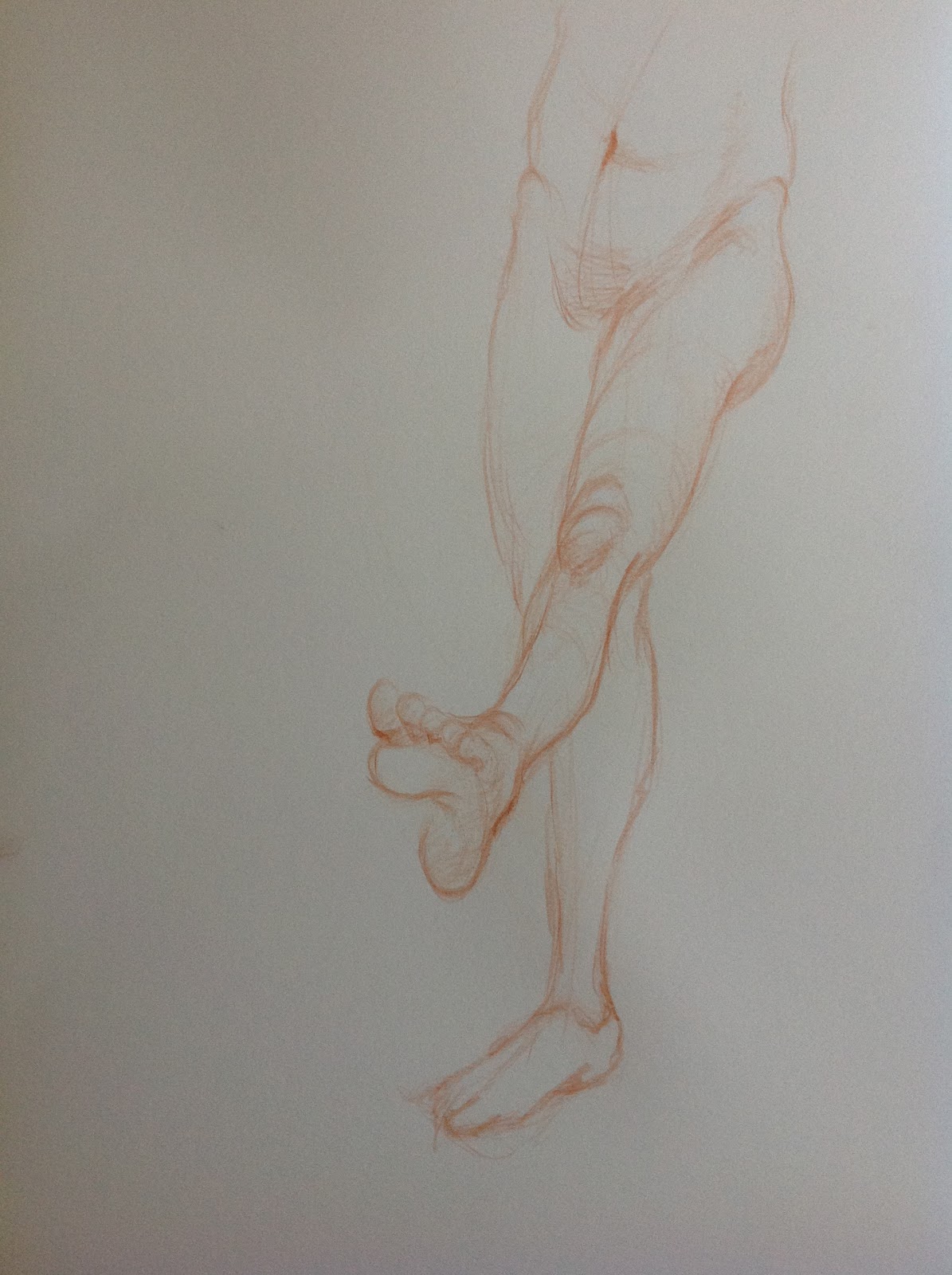
| Michael Whynot. Figure study, 2013. Red chalk. |
 |
Michael Whynot. Figure study, 2013. Red chalk.
|
Some poses are inherently more challenging to draw than others: namely, any pose where foreshortening and perspective come into play (hint: most of them). Much of the knowledge we learn about proportion goes out the window with these poses. This is where the draftsman's ability to measure comparatively, by eye, comes into play (see my
previous post on measuring). And even this can be a challenge, since depth is the most difficult measurement to judge. But describing the forms with a sense of dimensionality or volume can be achieved by a solid understanding of the forms and clarifying which form is in front and which is behind.
Overlapping forms is an aspect of drawing which is easily overlooked by the beginning draftsman. In an academic approach to drawing the figure, he or she is often taught to carefully draw the contour of the figure and, in so doing, they usually combine the contours of separate forms into one with a continuous line, flattening out the drawing and confusing the viewer.
The ability to see how one form fits into another allows the draftsman to emphasize the separation between the two. Taking a constructionist approach to the figure allows the draftsman to understand these forms. From this point there are several ways to clarify the overlapping forms: line weight and sensitivity being the foremost, but also emphasizing the forward form with tone and the use of atmospheric perspective.
The two drawings, above, are from Sunday's life drawing session and were each approximately 20 minutes long. Notice how I try to emphasize the line weight of the forward forms and subdue the weight of line on the forms which pass behind the forward forms. This is a process which takes much practice and must be utilized over every part of the figure (something which I haven't totally achieved on either drawing).
There are many elements to consider in a good drawing- overlapping forms is but one of many- and they must be considered simultaneously and completely internalized, so that they are done without thinking. This is a long process, and one reason why a constructionist approach to drawing the figure takes longer to become proficient in than an academic approach. But the results from a constructionist approach are usually more dimensional and beautiful (beautiful and accurate are not the same thing).
But all of the elements of good drawing stem from proper
seeing by the draftsman. And seeing is akin to understanding and visa versa (see my
previous post on drawing well). For, if the form is not clear in your mind's eye, it will never be clear in the viewer's eye.