Sunday, 26 April 2015

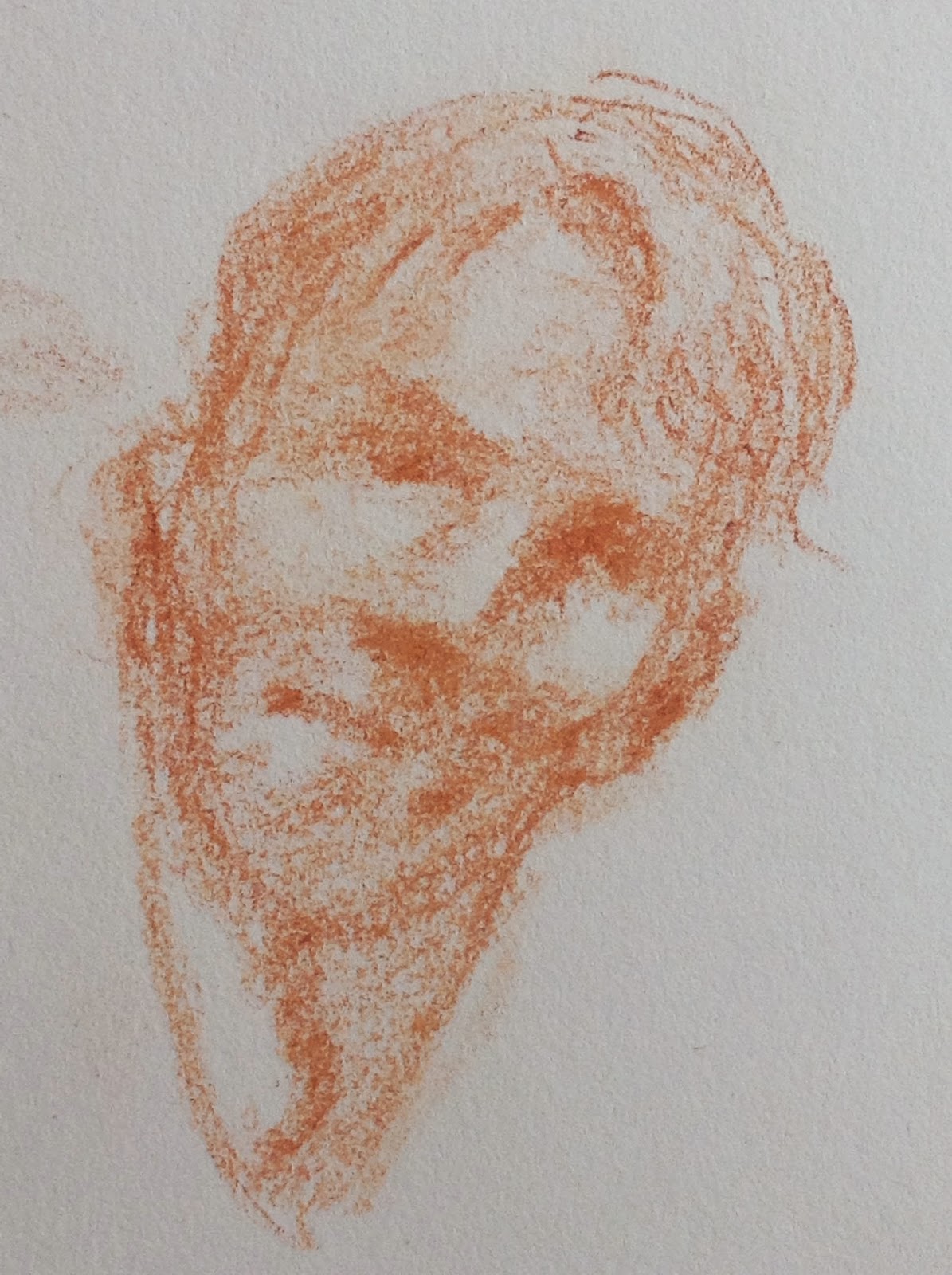
Study of Old Man with Beard.

Michael Whynot. Red chalk.


A fifteen minute study, done this morning in red chalk of an older man with a beard.

Tuesday, 14 April 2015

Light and Form.

Michael Whynot. Red chalk.


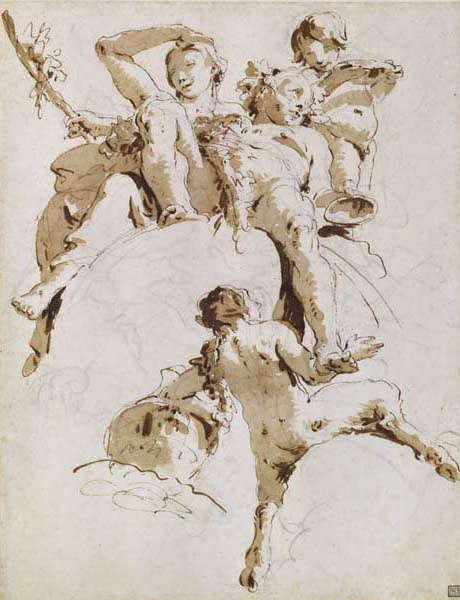
Tiepolo.


Tiepolo.


To depict the figure convincingly, one needs to understand how form is constructed and, also, how light will behave when interacting with the form.

Doing this with the live model, under well-lit conditions (a single light source), is the best way to study light. But once you have an understanding of light and form, you are free to create images from imagination and play with pose and composition.

The drawing, above, was done from imagination, last evening. It took about two hours from first gesture line to completion. There are so many aspects to consider when doing drawings like this from imagination, without the luxury of a model; like a juggler trying to juggle six balls, instead of three.

The two drawings below mine are by the Venetian painter Giovanni Battista Tiepolo (1696-1770). He was a master of light and form, and these pen and wash drawings show this master's complete understanding of both, and highlight how much work I have, yet, remaining.

Sunday, 12 April 2015

The Illusive Aspect of Movement.

Michael Whynot. Red chalk.

Michelangelo. Study for Hamen.


Here is a drawing done yesterday from imagination. I was trying to capture a sense of movement in the figure. This can be done with a live model, if you are very good at quick gestures, or with the use of supports for your model such as a rope or chair. But this is an area of drawing where the imagination shines. Literally, any pose you can imagine, can be drawn. Still, movement is difficult to depict (as it is when working from a live model). Stiffness always wants to creep in; overworking such a drawing can kill it. Often, any looseness you admired in your initial drawing disappears as you render. Less may be more in this instance.

Michelangelo called his sculpture viva - living. And this aspect can be seen in his drawings and paintings, as well. He strove for this sense of life; he considered this movement as one of the cornerstones of his art.

Monday, 6 April 2015

Red Chalk Drawing: Comparing Modern Alternatives with the Real Thing.

Michael Whynot. Red chalk.


Michael Whynot. Red chalk.

I am a big admirer of red chalk drawings from the renaissance. So much so, that it is my preferred drawing medium. But it's not as simple as that. The drawings made during the renaissance were actual red chalk, while what we usually draw with today are modern equivalents.

And they are not all created equal. There are red chalk-like alternatives made by Conte, Faber-Castell, and Prismacolor Verithins to name just three of the brands that I have tried personally. And they all have their faults and advantages.

Conte is very soft and makes achieving dark values easy. But I find that the binder used to bind the pigment is too oily and getting fine detail is difficult in smaller drawings.

The Prismacolor and Faber-Castell brands use a waxy binder that makes it easier to get fine details but hard to get a dark value.

I have started using natural sanguine recently, which is an actual red chalk that comes in chunks which need to be cut or sanded into a convenient shape for drawing.

The first drawing above was made with a Faber-Castell pencil and the bottom was made with real red chalk. The red chalk is much drier than any of the man-made pencils, but not as easy to work with. It tends to be inconsistent from one piece to another. Some can be very crumbly while others are too hard. But I like the feel of it, when you get a good chunk; it has a nice pull against the paper. And gaining a dark value is easy. Fine detail, though, is also difficult to achieve with smaller drawings.

It will take some getting used to, but the real red chalk gives a glowing aspect to a drawing that seems to be missing from the man-made alternative. I like its rich, vibrant warmth.

Sunday, 5 April 2015

The Nude Figure and the Clothed Figure.

Michael Whynot. Study of mother and child. Red chalk.


Michael Whynot. Figure study. Red chalk.


Here are a couple of studies done this morning, one nude and one clothed. The drawing of nude figures, although beautiful in themselves, have also been used as preparation for clothed figures at least since the renaissance.

So much in drawing is about the understanding of form, and once the draftsman understands how the body is constructed, it then becomes a matter of wrapping the figure in clothing, just as an understanding of the skeletal system serves to ease the draftsman's ability to wrap the skeleton in muscles and flesh.

Friday, 3 April 2015

Bits, Pieces and Random Doodles.

Michael Whynot.


Michael Whynot.


Michael Whynot.


Michael Whynot.


Michael Whynot.


Nothing important to talk about today; just some bits and pieces laying on the drawing desk. I'm always drawing random doodles in the margins when I'm writing and on the corners of any handy paper when I'm reading; never producing anything of merit, but hopefully pointing to a mindset preoccupied with form.

Wednesday, 25 March 2015

Beauty, Expressiveness and the Human Figure.

Michael Whynot. Figure Study. Red chalk.


The range of beauty and expressiveness possible within the attitude of the human figure never fails to leave me with a sense of wonder. The flesh is the veil through which we glimpse the soul.

Is it any wonder that the figure has been the focus of art since we first began to draw?

The drawing above began with a few quick gesture lines. I had a simple twist of the torso in mind when I set down with my drawing pad. I began to explore the figure on the paper, changing the gesture lines for the neck, arms and legs. The range of possibilities was nearly endless.

An hour later, I had this expressive figure on the page, the head lolling against the shoulder, knee thrusting forward, arms spread wide.

A person could spend a lifetime exploring all the possibilities of the figure and, I dare say, it would not be a life wasted.