Thursday, 26 December 2013

Conception Verses Reality.

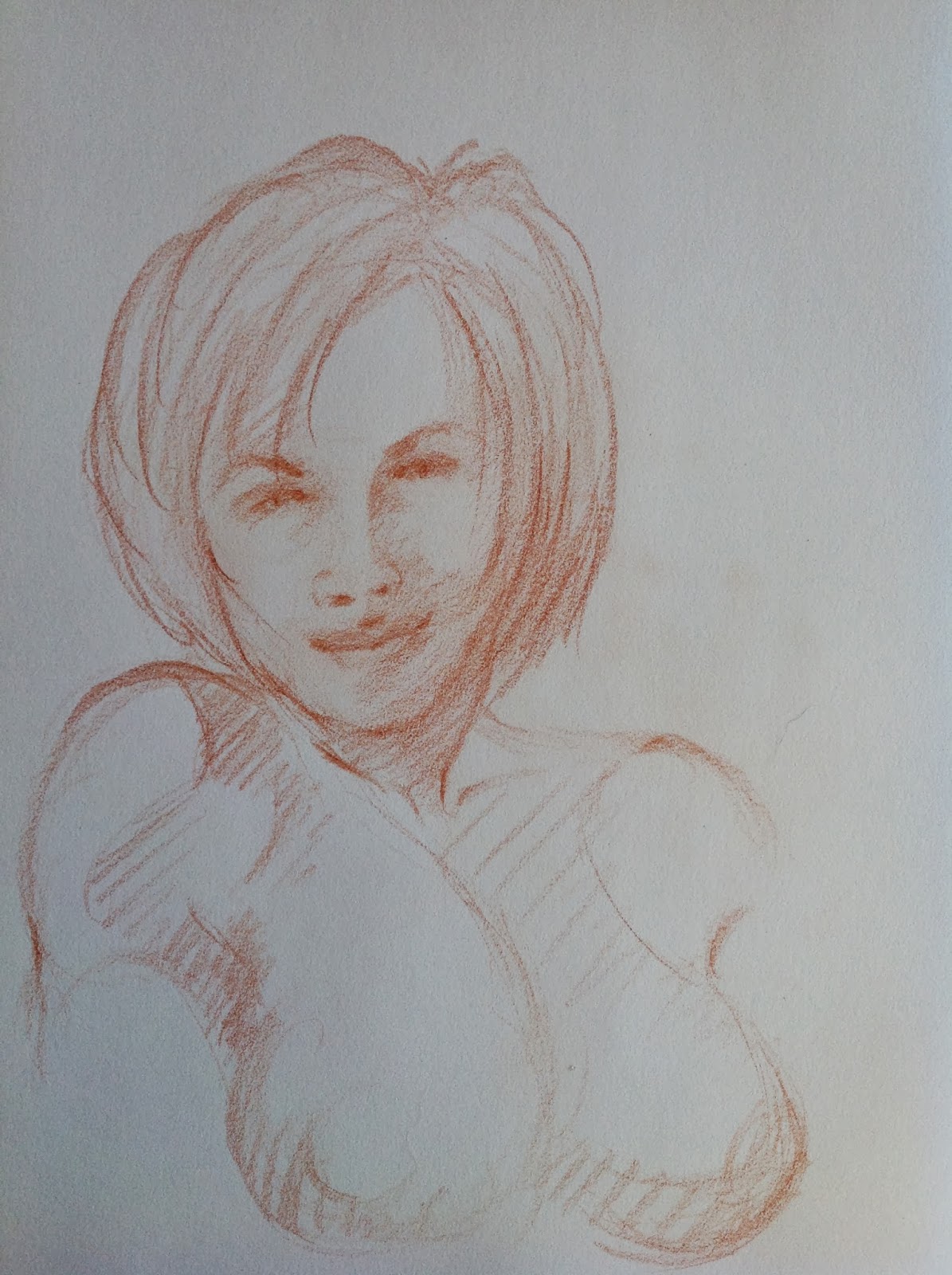
Michael Whynot. Head Study, 2013. Red chalk.


I wonder whether what I create conveys the reality, the beauty, of what I see, or, rather, merely the conception of what I see? And I fear that, while our creations may have a beauty in their own right, conveying the truth of what we see is impossible. How does one convey reality? Just attempt to describe it and you soon discover on what a slippery slope you're standing.

Monday, 21 October 2013

The Nature of Beauty.

Michael Whynot. Portrait Study, 2013. Red chalk.


Michael Whynot. Portrait Study, 2013. Red chalk.


What beauty is, I know not, though it adheres to many things. (Albrecht Durer)


I have begun to question the nature of beauty - and what, exactly, I am observing when I see that which I perceive as beautiful.

Is beauty intrinsic in an object or is beauty a quality of a perceptive mind?

Beauty must be subjective, as evidenced by the wide range of what is accepted as beautiful. But, it seems to me, that subjective beauty is mostly cosmetic; mere surface appearance. If we can get past our conceptions of what we believe beauty to be, and allow perception to be immediate and unencumbered by thought, then beauty may show itself to be universal and self-evident; a quality as real as truth or goodness.

Wednesday, 4 September 2013

Ideal Form: Michelangelo's Debt to the Ancient Greeks.

Michael Whynot. Torso Study after Greek sculpture, 2013. Red chalk.


Torso of Satyr. Ancient Greek.


Michelangelo. Last Judgement.

Torso Belvedere. Ancient Greek.

Michelangelo. Sistine Chapel study for Adam.

Michelangelo. Study for an Ignudo.

Michelangelo. Study for Haman.


The idea of beauty is the fundamental idea of everything. In the world we see only distortions of the fundamental idea, but art, by imagination, may lift itself to the height of this idea. Art is therefore akin to creation.  (Leo Tolstoy)

The artist is not a reporter, but a Great Teacher. It is not his business to depict the world as it is, but as it ought to be.  (H.C. Mencken)


Michelangelo understood the human form - understood its movement, its grace, its beauty. And, insofar as its depiction in drawing, painting and sculpture is concerned, one might almost believe that he had invented it. But he did not.

The Greeks discovered that naturalness of gesture over two thousand years ago; Michelangelo simply rediscovered it.

It seems we, as artists, periodically loose sight of this naturalness of form we call beauty or grace. Or, perhaps, there are simply very few artists who can perceive it; and, fewer still, who are able to utilize it freshly in their own work.

Many artists can copy a great work of art, but how many can successfully explore variations on that original concept? How many can expand upon and improve the concept - making it their own? This was Michelangelo's genius: his ability to understand ideal form and to be able to produce new variations of the two thousand year old concept from imagination alone.

And Michelangelo's exploration of those variations took the form of drawing - for, as brilliant as his sculpture and painting was (and it has rarely been equalled), it was through his drawings that he was able to wander along this path and discover new poses and forms, expanding our understanding of, and appreciation for, the beauty of the human form.

Michelangelo understood that the copying of nature was not the purpose of art. He embraced the idea of an ideal form that the ancient Greeks were seeking. He heard the call of perfection whispered across a two thousand year void and he repeated it aloud for those of us who would choose to listen.


I would like to include a link to the blog: The Best Artists. for a recent post comparing several of Michelangelo's works and the ancient Greek sculptures that inspired them. While I have been aware of Michelangelo's study of ancient Greek sculpture, I had not noticed the close correlation of some of his poses. An interesting post. 

Friday, 23 August 2013

The Head in Profile

Michael Whynot. A head in profile, 2013. Red chalk.


It's been nearly a month since my last post. I took a bit of a vacation and I have been trying to catch up on some much-needed yard work.

I spent an hour, this morning, studying the head in profile; the opportunity to show depth and volume being limited in this point of view. Try to distinguish, with tone or hatching, the side plane of the nose in contrast to the front plane of the cheek bone. The trapezius also conveys a sense of depth as it fits into the cylinder of the neck. The eye, nestled properly into its socket, and the hint of a cast shadow beneath the ear lobe also help. Not my favorite point of view.

Friday, 26 July 2013

Portrait Study from Life

Michael Whynot. Portrait study of Anne-Marie. Red chalk with white highlights, 2013.


Posting a short (fifteen minutes) study from last night's life session. I often wonder how much of an effect time has on our work? The fifteen minutes available for this study allowed for little more than a block-in with a couple of highlights to add dimensionality. Where would another fifteen minutes have led? Another thirty? An opportunity for improvement, or a chance to spoil the whole thing? I lie in bed at night and wonder about such alternatives: opportunities lost or blessings in another guise.

Sunday, 14 July 2013

A Milestone Reached.

Michelangelo. Creation of Adam.


Beauty is a value as important as truth and goodness. I think we are loosing beauty and there is a danger that, with it, we will loose the meaning of life.    (Roger Scruton)


This blog reached a milestone today: ten thousand page views during the last twelve months.

When I began posting, last August, I meant to explore my ideas concerning the beauty inherent in natural forms - particularly the human form - and to chronicle my journey toward attaining the abilities necessary to depict that beauty in drawing, painting and sculpture, much as Praxiteles, Leonardo da Vinci, Michelangelo and Raphael had done before me.

I have come a long way, but have much further, yet, to go. I would like to thank everyone who has been following my posts, these last twelve months. I hope that you will continue to follow my journey; I hope my work proves worthy of your interest.

Drawing Between the Lines: Achieving Dimensionality.

Michael Whynot. Leg study in red chalk, 2013.


I began this post by preparing to upload a recent leg study without much in the way of commentary, but then I took a moment to consider the process of what I had drawn. Achieving a sense of dimensionality in the figure doesn't just happen; and it certainly won't happen by slavishly copying the external contours of the figure.

The eye of the viewer must be coaxed inside the form and away from the external contour. The way to do this is by not placing a hard outline around your forms, which is exactly what most beginning draftsmen struggle obsessively to copy from the model. Line quality and line weight are tied intrinsically to this aspect of good drawing.

Where to emphasize or not emphasize an external contour is an aesthetic decision that really defies rules, so study Michelangelo, Raphael, Da Vinci and Pontormo to understand how it should look when done well.

To persuade the viewer's eye to dwell within the contours, you must give it something to look at. The nearer forms must be modelled upon those forms which are farther away; in this way, depth is achieved.

Creating the appearance of dimensionality of a three dimensional form in space upon a two dimensional surface is not easy, but the sense of wonder it elicits is magical and well-worth our time and study.