Saturday, 7 March 2015

Upon Closer Examination: Drawing and the Beauty in the Details.

Michael Whynot. Figure study. Red chalk.


Michael. Detail.


Michael Whynot. Head study. Red chalk.


Michael Whynot. Detail.


Michelangelo. Head of a Young Man  C. 1516.


Michelangelo. Detail.


There is something wondrous about drawing: this ability to illuminate the three dimensional world of forms upon a two dimensional medium - light where there is no light, shade where there is no shade, and form where there is no form. Simply amazing.

And, as beautiful as drawings are, we can often be so beguiled by the illusion of three dimensions where there are only two, that we fail to examine, closely, the actual marks themselves that created the illusion. And in so doing, I would argue that we miss the beauty inherent in the details themselves.

The lines of a drawing reveal themselves not merely as the edges of forms, but serve to describe form beautifully as they travel over the surface, creating patterns as they bunch up and spread out, flowing in one direction and then another.

If you truly wish to appreciate a good drawing, and draw better yourself, don't be content with studying the big picture; examine the details and you may come away with a better understanding of the drawing and the wondrous illusion it creates.

Wednesday, 25 February 2015

The Sum of the Parts.

Michael Whynot. Figure study. Red chalk.


Michael Whynot. Foot study. Red chalk.


Michael Whynot. Hand study. Red chalk.


Aristotle wrote that: "The whole is greater than the sum of its parts." And, while this is certainly true of the human form, where the inherent flow of gesture from one body part to the next can create a grace and emotional connection more profound than the summation of the individual pieces, I would argue that the individual forms, when studied in isolation, can convey a grace and beauty all their own.

There is no question of the wondrous flow of gesture through the legs, hips and torso above, yet, if you study the arm or the leg and the attached hand or foot, taken in isolation, you will find the same ebb and flow through these parts as well.

The organic form is a wonder of engineering, evolution, or creation (whichever term you prefer). It has captivated our souls and our art since we first made marks upon the walls of dimly lit caves and it continues to captivate us today. The fact that such continuity of form, that flowing gesture of grace, is evident no matter how small a piece of the whole we observe, speaks to the profound truth of Aristotle's quote. The whole is, indeed, greater than the sum of its parts, which is greater than the sum of its parts, which is greater than the sum of its parts… ad infinitum.

Sunday, 22 February 2015

A Mind for Figures.

Michael Whynot. Figure study. Red chalk.


Michael Whynot. Figure study. Red chalk.


This is my first post in over a year. I must admit to having these recurring bouts of fatigue and self-doubt. Doubt in my ability, my goals, and my own will to accomplish them. On such days, I feel that nothing I create is of any worth and that I have progressed as far as I am able to. These are the times when I find it much easier to become side-tracked, by my other diverse interests, than to draw. It's like watching a baseball being thrown at your head, but being unable to step out of harms way.

I am trying to get back on track, though, with this new post and these two drawings from imagination. The human figure occupies my mind constantly and drawing seems to be the only way to release them.

Aristotle said: "We are what we repeatedly do. Excellence, therefore, is not an act but a habit."
So, I will attempt to get back into the habit of drawing regularly every day. Wish me luck and, if you like these figure studies, please share your thoughts.

Thursday, 26 December 2013

Conception Verses Reality.

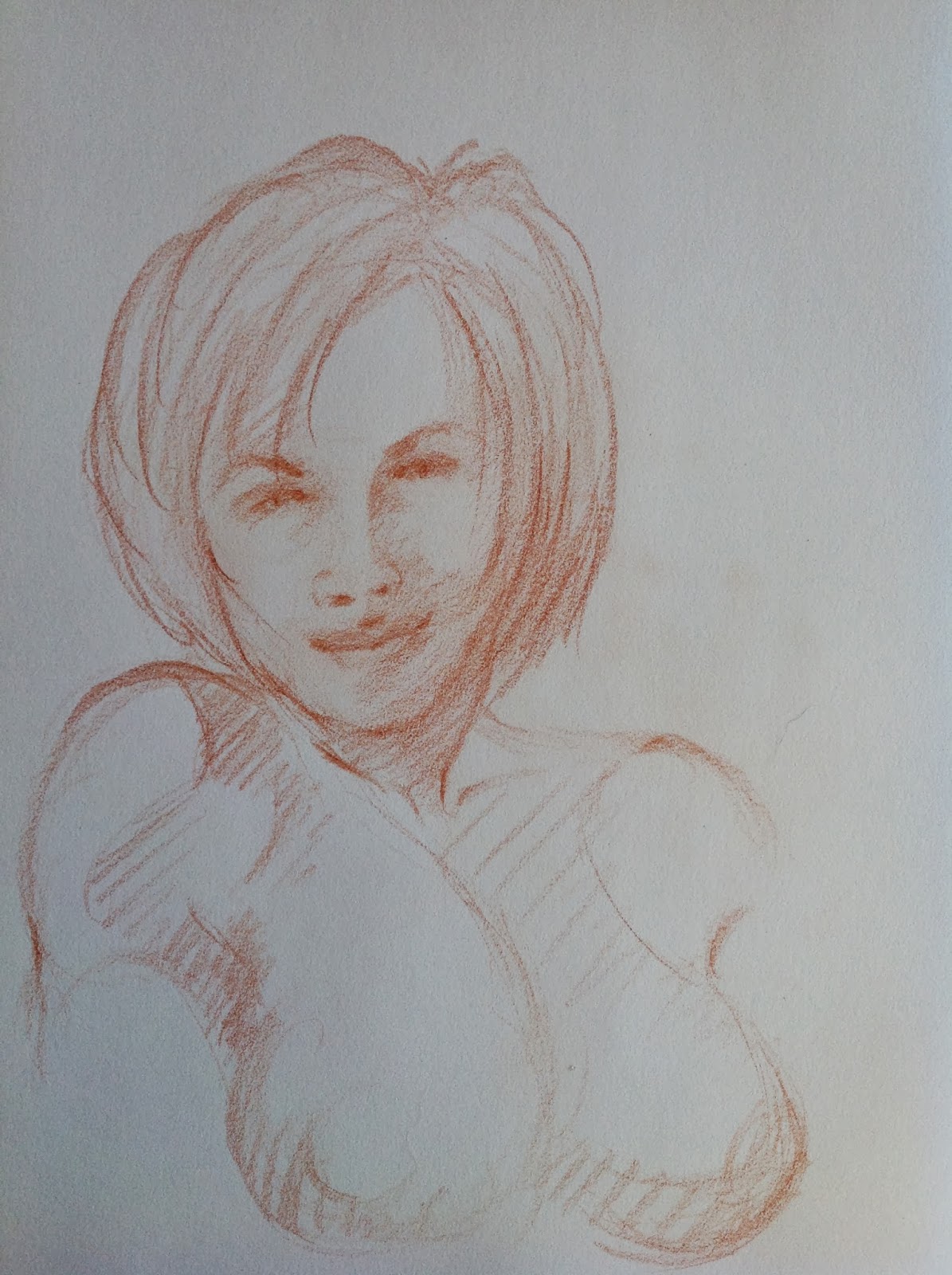
Michael Whynot. Head Study, 2013. Red chalk.


I wonder whether what I create conveys the reality, the beauty, of what I see, or, rather, merely the conception of what I see? And I fear that, while our creations may have a beauty in their own right, conveying the truth of what we see is impossible. How does one convey reality? Just attempt to describe it and you soon discover on what a slippery slope you're standing.

Monday, 21 October 2013

The Nature of Beauty.

Michael Whynot. Portrait Study, 2013. Red chalk.


Michael Whynot. Portrait Study, 2013. Red chalk.


What beauty is, I know not, though it adheres to many things. (Albrecht Durer)


I have begun to question the nature of beauty - and what, exactly, I am observing when I see that which I perceive as beautiful.

Is beauty intrinsic in an object or is beauty a quality of a perceptive mind?

Beauty must be subjective, as evidenced by the wide range of what is accepted as beautiful. But, it seems to me, that subjective beauty is mostly cosmetic; mere surface appearance. If we can get past our conceptions of what we believe beauty to be, and allow perception to be immediate and unencumbered by thought, then beauty may show itself to be universal and self-evident; a quality as real as truth or goodness.

Wednesday, 4 September 2013

Ideal Form: Michelangelo's Debt to the Ancient Greeks.

Michael Whynot. Torso Study after Greek sculpture, 2013. Red chalk.


Torso of Satyr. Ancient Greek.


Michelangelo. Last Judgement.

Torso Belvedere. Ancient Greek.

Michelangelo. Sistine Chapel study for Adam.

Michelangelo. Study for an Ignudo.

Michelangelo. Study for Haman.


The idea of beauty is the fundamental idea of everything. In the world we see only distortions of the fundamental idea, but art, by imagination, may lift itself to the height of this idea. Art is therefore akin to creation.  (Leo Tolstoy)

The artist is not a reporter, but a Great Teacher. It is not his business to depict the world as it is, but as it ought to be.  (H.C. Mencken)


Michelangelo understood the human form - understood its movement, its grace, its beauty. And, insofar as its depiction in drawing, painting and sculpture is concerned, one might almost believe that he had invented it. But he did not.

The Greeks discovered that naturalness of gesture over two thousand years ago; Michelangelo simply rediscovered it.

It seems we, as artists, periodically loose sight of this naturalness of form we call beauty or grace. Or, perhaps, there are simply very few artists who can perceive it; and, fewer still, who are able to utilize it freshly in their own work.

Many artists can copy a great work of art, but how many can successfully explore variations on that original concept? How many can expand upon and improve the concept - making it their own? This was Michelangelo's genius: his ability to understand ideal form and to be able to produce new variations of the two thousand year old concept from imagination alone.

And Michelangelo's exploration of those variations took the form of drawing - for, as brilliant as his sculpture and painting was (and it has rarely been equalled), it was through his drawings that he was able to wander along this path and discover new poses and forms, expanding our understanding of, and appreciation for, the beauty of the human form.

Michelangelo understood that the copying of nature was not the purpose of art. He embraced the idea of an ideal form that the ancient Greeks were seeking. He heard the call of perfection whispered across a two thousand year void and he repeated it aloud for those of us who would choose to listen.


I would like to include a link to the blog: The Best Artists. for a recent post comparing several of Michelangelo's works and the ancient Greek sculptures that inspired them. While I have been aware of Michelangelo's study of ancient Greek sculpture, I had not noticed the close correlation of some of his poses. An interesting post. 

Friday, 23 August 2013

The Head in Profile

Michael Whynot. A head in profile, 2013. Red chalk.


It's been nearly a month since my last post. I took a bit of a vacation and I have been trying to catch up on some much-needed yard work.

I spent an hour, this morning, studying the head in profile; the opportunity to show depth and volume being limited in this point of view. Try to distinguish, with tone or hatching, the side plane of the nose in contrast to the front plane of the cheek bone. The trapezius also conveys a sense of depth as it fits into the cylinder of the neck. The eye, nestled properly into its socket, and the hint of a cast shadow beneath the ear lobe also help. Not my favorite point of view.