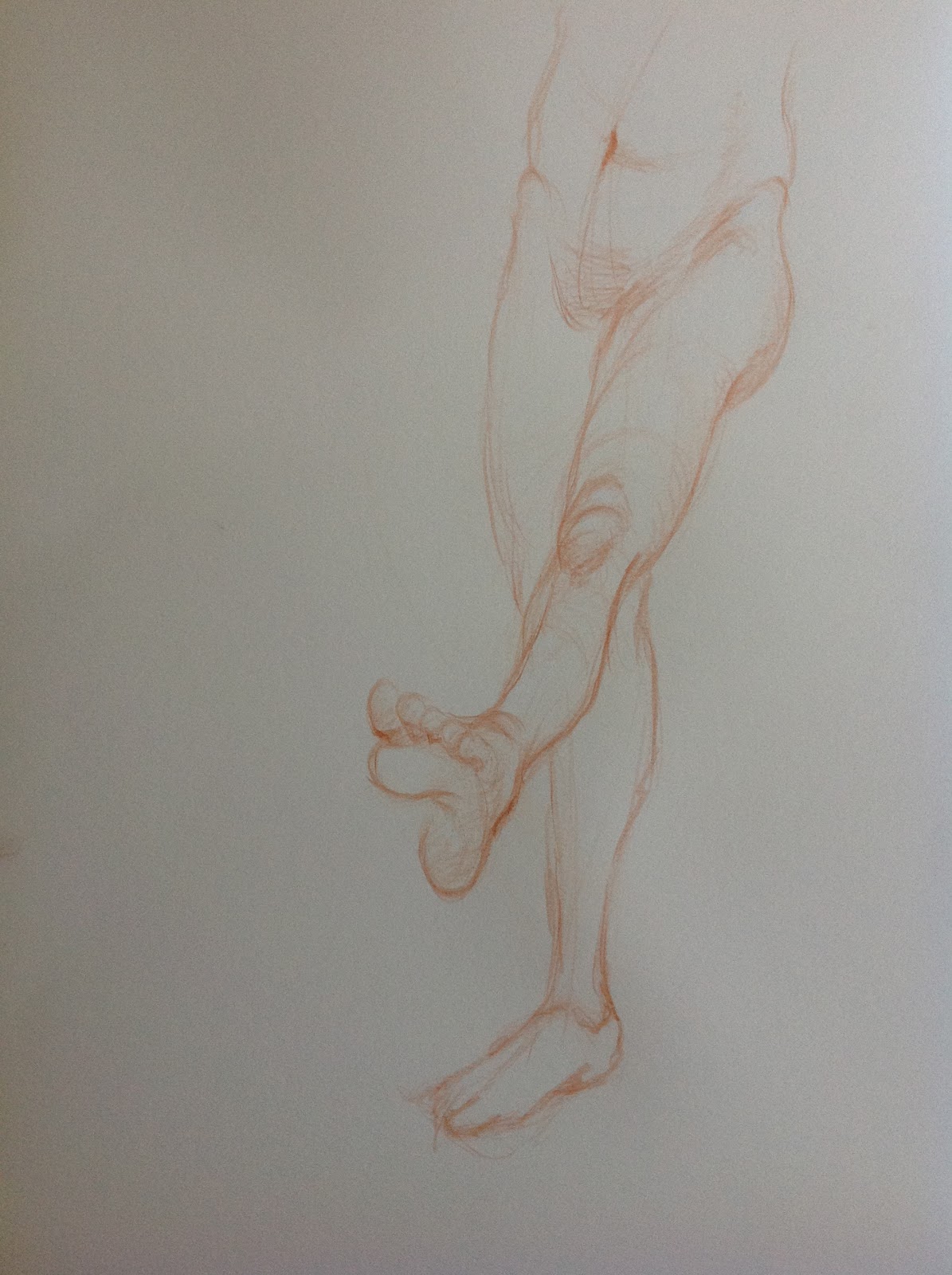
Sunday, 30 June 2013

The Lure of Anatomy: Part 2.

Michael Whynot. Study of Arms At Rest and in Tension, 2013. Red chalk.


Michelangelo. Study for Haman.

Raphael. Study for the Massacre of the Innocents. 

Rembrandt. Seated Old Man in Armchair.


Today I had a question from one of the newer readers of this blog, asking if I had any tips on drawing muscles.

In a previous post (The Lure of Anatomy), I discussed, at length, when and why I believed that the study of anatomy is most beneficial to a new draftsman.

Muscles are no different than any other form: the better you understand the form, the better you will draw it. And the more frequently you draw it, the better you will understand it. It is a cyclically beneficial method of learning: drawing leads to understanding, understanding leads to better drawing, which leads to better understanding...(See my previous post on The Act of Drawing Well).

Having said that - drawing muscles well, like any other form, is best accomplished with a multi-pronged approach.

Draw from the live model as frequently as possible - there is no substitute to drawing from life. But understand that the amount of information on the live model will be immense and confusing for the new draftsman. And complicating the process will be colour, value, poor lighting, etc.

A good anatomy book will prove indispensable. It will help you to understand the confusing wealth of information on the live model.

Drawing from (i.e. copying- it is not a bad thing) master drawings. This is one of the most beneficial exercises that the new draftsman can practice. Artists throughout history have been doing it. It is how we learn to see what they saw - which elements they emphasized, which elements they downplayed or eliminated, altogether. Learn from Michelangelo, Raphael, Da Vinci and Rembrandt - there are no finer teachers, so utilize them.

In regards to drawing muscles, per se - they are rendered the same as any other form: they are three dimensional volumes with a width, height and depth and should be drawn as such. But remember that muscles change their appearance constantly, so simple recipes for drawing them are mostly useless.

I have included a study of two arms to illustrate the difficultly of drawing muscles. Remember, a muscle at rest is shaped differently than the same muscle in tension. Note in my study, that Biceps Brachii, in the arm at rest, is longer and flatter, while in the arm in tension, it is shorter and higher. This is the nature of muscles and applies to every one of them.

Orientation of the muscle in space will also affect how we draw them: look at your own biceps, from above, and then rotate to view it from the side - a totally different shape and relationship to the surrounding forms.

There is no easy way to learn to draw the human form. Study from life and from reference and, from that point on, it's all repetition, repetition, repetition.

And, a final point: anatomy should never be the embarking point for the draftsman. Gesture is the most important, and often neglected, element in drawing. Note, in the beautiful studies above, that the anatomy is wondrous in all three, but prominent in the Michelangelo and Raphael drawings, while, in Rembrandt's drawing, it is mostly hidden beneath drapery - but gesture is the foundation upon which all the other elements are built.

Anatomy is beautiful, in and of itself, but gesture conveys the life of a drawing: neglect it at your peril.

Saturday, 29 June 2013

Random Study: A page from my sketch book.

Michael Whynot. Random Study, 2013. Red chalk.


Posting a random page from my sketchbook. A female head study and a fragment of a leg and torso. Hope you like them.

Saturday, 15 June 2013

Study of the Arm and Hand.

Michael Whynot. Study of the Arm and Hand (after Michelangelo's sculpture, Victory), 2013. Red chalk.

I'm posting a study of the arm and hand (after Michelangelo's sculpture, Victory). I completed it this morning (20-30 minutes).

 There is something magical in Michelangelo's figures; some movement or flow of the forms which is missing from many other artist's work. We should explore his work closely if we want to elevate our own work. There is a reason why he is still revered nearly 450 years later. Study his forms closely; there are secrets to be found there.

Sunday, 9 June 2013

Portrait Study: Stephen Resting.

Michael Whynot. Portrait Study: Stephen Resting, 2013. Red chalk.

I'm posting a short (30 minutes) portrait study from this morning. Capturing a likeness in a portrait is an elusive thing and, in some respects, more difficult than the figure. Many elements come into play. Being off a quarter of an inch in judging your measurements of the figure goes completely unnoticed, but being off the same distance in the spacing of the eyes or the length of the nose in a portrait will jump out immediately.

And, even once you have nailed the measurements, the more intangible elements of expression and gesture or attitude can elevate a portrait or hasten its slide into ruin.

We can continue to grow with each portrait attempted, but the learning curve is steep and the slope dangerously slippery, the path changing continually under foot with each new subject.

Friday, 31 May 2013

Foreshortening Forms

Michael Whynot. Study in Foreshortening, 2013. Red chalk.


Foreshortening is a powerful tool for the draftsman to add dimensionality to their drawings. When forms recede from our view in space they become smaller. We are so accustomed to seeing this optical trick in nature that our minds take it for granted and immediately notice, in a drawing, when this isn't done.

When handled properly, by using overlapping forms, the drawing gains dimensionality, with the nearer forms appearing to be in front of the more distant forms. And the form will appear shorter than we know it to be, instead of simply looking out of proportion.

The above study was a five minute study from life.

Sunday, 26 May 2013

The Poetry of Movement.

Michael Whynot. Figure Study, 2013. Red chalk.


Michael Whynot. Torso Studies, 2013. Red chalk.

I'm posting two studies taken from my sketchbook from yesterday. There is such beauty in the movement of the human form, rhythm serpentining through the figure, uniting the parts; reminiscent of poetry or music, yet perceived by the eye, instead of the ear. I suspect that some rhythms may be uplifting, while others appear depressing, joyous or sad.

Just as music or poetry can touch us in spiritual ways - which we have all felt, yet, ultimately, been unable to explain - so too, movement of form has the same power to inspire. Such is the mystery of great art, in all its forms.

The figure is capable of conveying a multitude of emotion through its movements. I continue to explore its limits with constant wonder and awe.

Monday, 20 May 2013

Robert Liberace

Robert Liberace

Robert Liberace

Robert Liberace

Robert Liberace

Robert Liberace


Since I began this blog, last year, I have been documenting my journey as a figurative artist by posting my own work and thoughts on figurative drawing, sculpture and painting, as well as some of my influences from the classical tradition: Michelanglo, Da Vinci and Raphael.

I have shied away from pointing to many living influences, because, often times, such lists can end up looking like a sort of popularity contest. That being said, I would like to suggest that we, as draftsmen, should take a serious look at the work of Robert Liberace, whose work compares very favourably to the classical influences I mentioned, above.

Mr. Liberace's figures capture the elusive aspect of movement, furia, which (along with grace, grazia, and variety, varieta) was one of the cornerstones of renaissance art. During that period, great importance was placed upon the appearance of physical movement as an expression of the movements of the soul. We are now rediscovering these aesthetic values in figurative art, five centuries later.

I have been following Mr. Liberace's work for several years and he and his wife, Lina, have kindly posted a link to this blog on their web site. And, if you are serious about figurative art, you owe it to yourself to view his web site and closely study this master's work.