Monday, 23 March 2015

The Advantage of Drawing from Imagination.

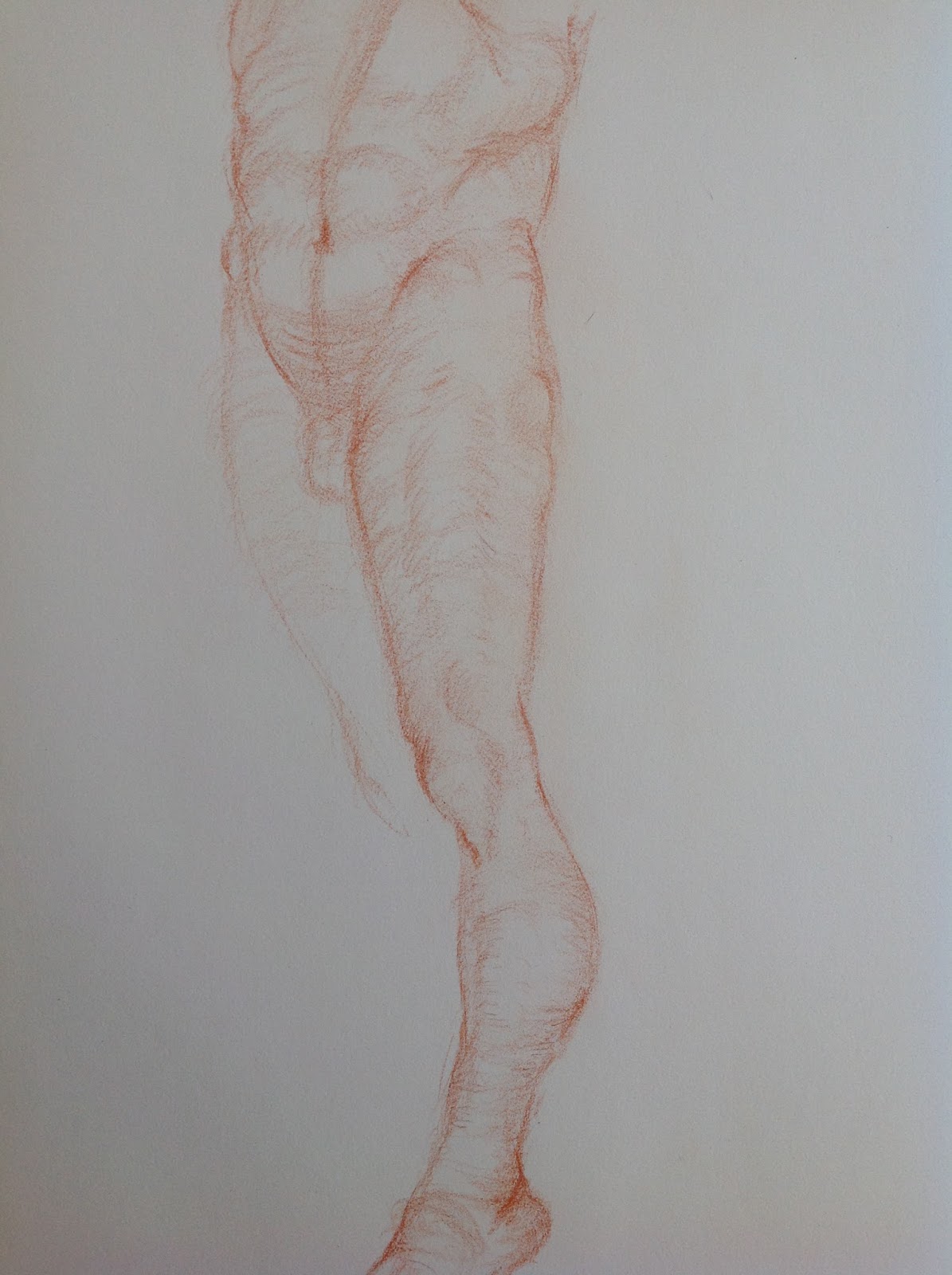
Michael Whynot. Leg study. Red chalk.


I am posting a leg study done this morning in red chalk. Once again, this was done from imagination. I have been away from drawing the live model for some time now, but I am finding that I still retain my basic understanding of the human form and how it is constructed. I will soon go back to the live model to make sure that I am not missing the many nuances that go hand in hand with changes in viewpoint, lighting and individual body shapes.

I believe this ability to draw from imagination is a necessity if an artist wants to move on from portraiture to multiple figure works, where having live models pose for the composition could be daunting. Drawing from imagination allows us the freedom to explore themes and poses before committing to live models to capture nuance.

The human form offers incredible possibilities in terms of its movement and multiple figures make these possibilities nearly infinite. Imagination allows us to explore these infinite variables of composition. In short, the ability to draw from imagination is the key to the creative process.

Wednesday, 18 March 2015

Snow Day Drawings

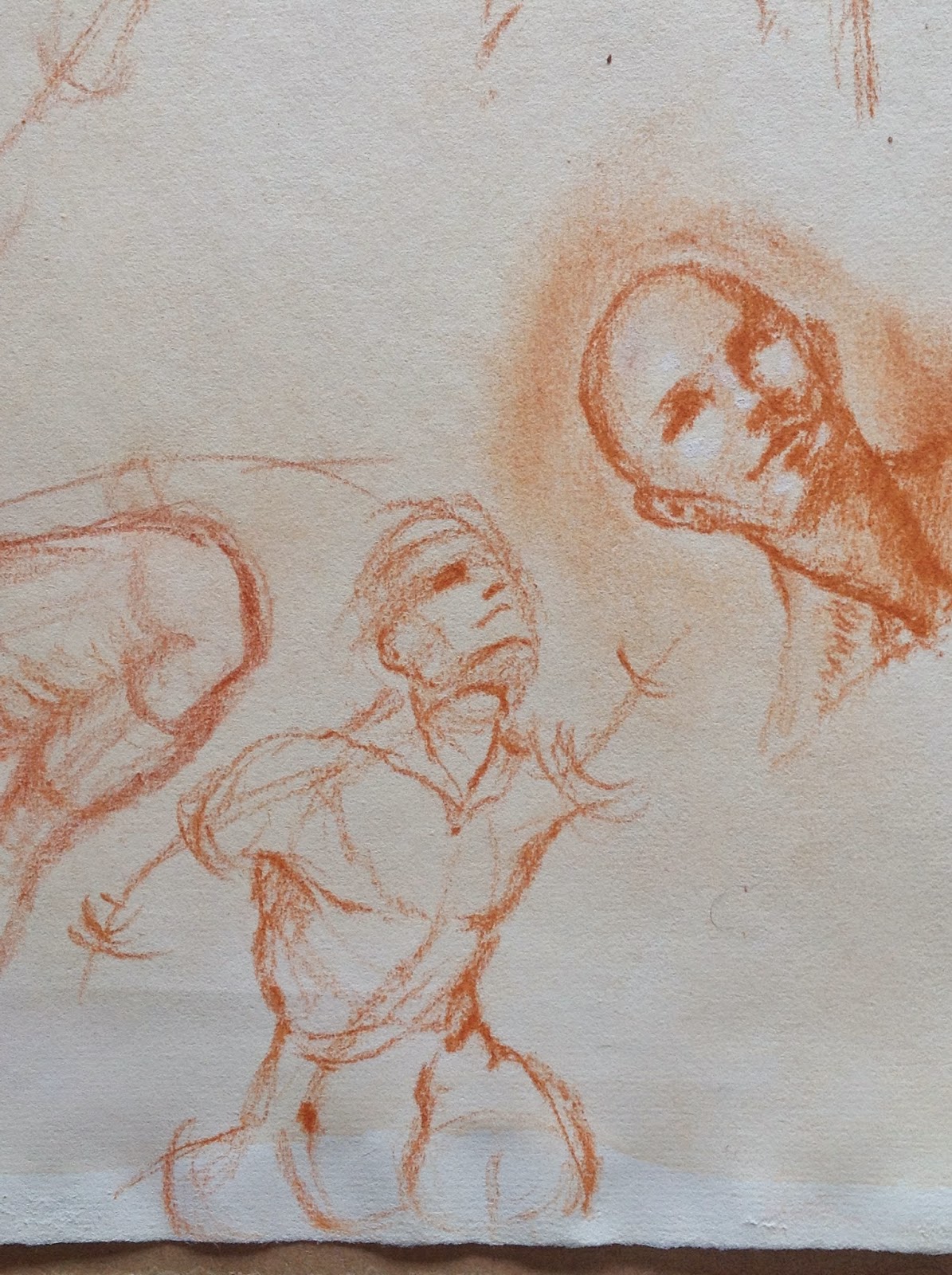
Michael Whynot. Red chalk gesture drawings.

Detail.


Detail.


We received a huge amount of snow here, last night and this morning; spring can't get here soon enough.

On the bright side, it gave me an hour to play around with some  rough gesture drawings, exploring different poses for the figure. This is where you can give your drawing free rein without the constraints of drawing directly from life. And it's a lot of fun.

Saturday, 7 March 2015

Upon Closer Examination: Drawing and the Beauty in the Details.

Michael Whynot. Figure study. Red chalk.


Michael. Detail.


Michael Whynot. Head study. Red chalk.


Michael Whynot. Detail.


Michelangelo. Head of a Young Man  C. 1516.


Michelangelo. Detail.


There is something wondrous about drawing: this ability to illuminate the three dimensional world of forms upon a two dimensional medium - light where there is no light, shade where there is no shade, and form where there is no form. Simply amazing.

And, as beautiful as drawings are, we can often be so beguiled by the illusion of three dimensions where there are only two, that we fail to examine, closely, the actual marks themselves that created the illusion. And in so doing, I would argue that we miss the beauty inherent in the details themselves.

The lines of a drawing reveal themselves not merely as the edges of forms, but serve to describe form beautifully as they travel over the surface, creating patterns as they bunch up and spread out, flowing in one direction and then another.

If you truly wish to appreciate a good drawing, and draw better yourself, don't be content with studying the big picture; examine the details and you may come away with a better understanding of the drawing and the wondrous illusion it creates.

Wednesday, 25 February 2015

The Sum of the Parts.

Michael Whynot. Figure study. Red chalk.


Michael Whynot. Foot study. Red chalk.


Michael Whynot. Hand study. Red chalk.


Aristotle wrote that: "The whole is greater than the sum of its parts." And, while this is certainly true of the human form, where the inherent flow of gesture from one body part to the next can create a grace and emotional connection more profound than the summation of the individual pieces, I would argue that the individual forms, when studied in isolation, can convey a grace and beauty all their own.

There is no question of the wondrous flow of gesture through the legs, hips and torso above, yet, if you study the arm or the leg and the attached hand or foot, taken in isolation, you will find the same ebb and flow through these parts as well.

The organic form is a wonder of engineering, evolution, or creation (whichever term you prefer). It has captivated our souls and our art since we first made marks upon the walls of dimly lit caves and it continues to captivate us today. The fact that such continuity of form, that flowing gesture of grace, is evident no matter how small a piece of the whole we observe, speaks to the profound truth of Aristotle's quote. The whole is, indeed, greater than the sum of its parts, which is greater than the sum of its parts, which is greater than the sum of its parts… ad infinitum.

Sunday, 22 February 2015

A Mind for Figures.

Michael Whynot. Figure study. Red chalk.


Michael Whynot. Figure study. Red chalk.


This is my first post in over a year. I must admit to having these recurring bouts of fatigue and self-doubt. Doubt in my ability, my goals, and my own will to accomplish them. On such days, I feel that nothing I create is of any worth and that I have progressed as far as I am able to. These are the times when I find it much easier to become side-tracked, by my other diverse interests, than to draw. It's like watching a baseball being thrown at your head, but being unable to step out of harms way.

I am trying to get back on track, though, with this new post and these two drawings from imagination. The human figure occupies my mind constantly and drawing seems to be the only way to release them.

Aristotle said: "We are what we repeatedly do. Excellence, therefore, is not an act but a habit."
So, I will attempt to get back into the habit of drawing regularly every day. Wish me luck and, if you like these figure studies, please share your thoughts.

Thursday, 26 December 2013

Conception Verses Reality.

Michael Whynot. Head Study, 2013. Red chalk.


I wonder whether what I create conveys the reality, the beauty, of what I see, or, rather, merely the conception of what I see? And I fear that, while our creations may have a beauty in their own right, conveying the truth of what we see is impossible. How does one convey reality? Just attempt to describe it and you soon discover on what a slippery slope you're standing.

Monday, 21 October 2013

The Nature of Beauty.

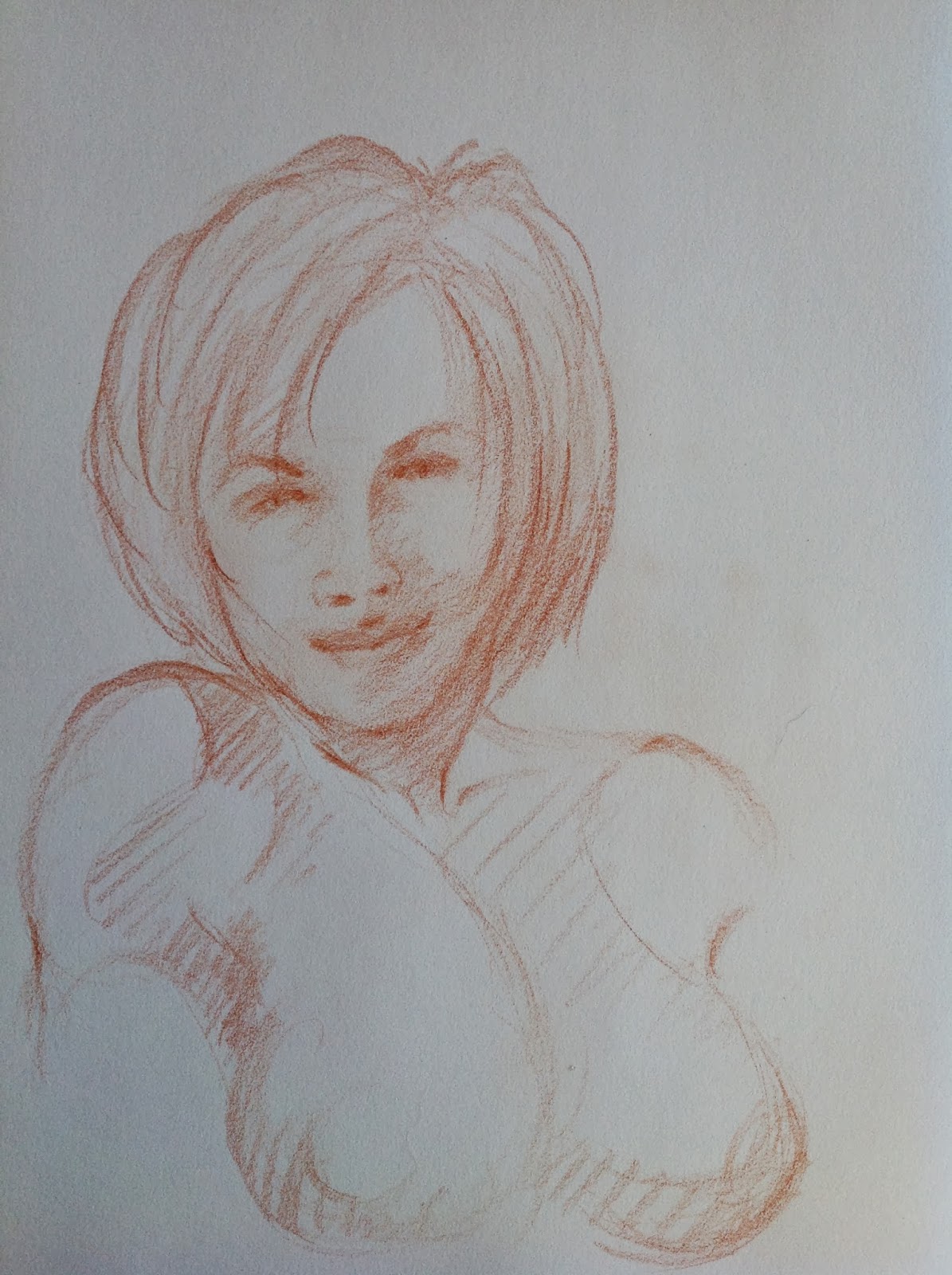
Michael Whynot. Portrait Study, 2013. Red chalk.


Michael Whynot. Portrait Study, 2013. Red chalk.


What beauty is, I know not, though it adheres to many things. (Albrecht Durer)


I have begun to question the nature of beauty - and what, exactly, I am observing when I see that which I perceive as beautiful.

Is beauty intrinsic in an object or is beauty a quality of a perceptive mind?

Beauty must be subjective, as evidenced by the wide range of what is accepted as beautiful. But, it seems to me, that subjective beauty is mostly cosmetic; mere surface appearance. If we can get past our conceptions of what we believe beauty to be, and allow perception to be immediate and unencumbered by thought, then beauty may show itself to be universal and self-evident; a quality as real as truth or goodness.